


Technical Support for Carrier Linearization
- 2026-07-09
- 223
I. Purpose of Linearization
The primary function of a vector is to carry the target gene into the host cell. Only when the vector is in a linearized state can it undergo recombination with the exogenous target gene to construct a recombinant plasmid.
Unlike prokaryotic expression, in yeast expression, plasmids or vectors used for transformation often do not contain yeast’s own replication origin. If a circular recombinant plasmid is directly transformed into yeast cells, it cannot persist stably; therefore, it must first be linearized and then integrated into the yeast chromosome via homologous recombination, ensuring that the target gene is stably expressed in yeast cells.
II. Common Vectors in the Yeast System
Yeast vector types include yeast cloning vectors, yeast expression vectors, and yeast artificial chromosomes (YACs).
(1) Yeast cloning vectors: These do not contain a yeast promoter and cannot express exogenous genes in yeast. They can be divided into two categories:
a. Yeast integrated plasmid (Yip): Contains a yeast URA3 marker gene and E. coli replication and reporter genes. Due to homologous recombination between the plasmid DNA and the yeast genomic DNA, integrated replication of the plasmid can be detected in transformed cells; the transformants are stable, but the transformation efficiency is extremely low.
b. Yeast replicable plasmids (Yrp): These vectors can self-replicate in yeast and primarily include YRp, YEp, and YCp.
Yeast replicable plasmids (YRp): Bacterial plasmid DNA + yeast genetic marker + yeast replication sequence (ARS); they can replicate autonomously but have poor stability.
Yeast add-on plasmids (YEp): Bacterial plasmid DNA + yeast marker gene + yeast 2 μm plasmid; they exist freely outside the nucleus and replicate autonomously, with good stability. The 2 μm plasmid contains an autonomous replication origin (ori) and an STB region; the STB sequence enables the plasmid to remain stable in donor cells.
Yeast centromeric plasmid (YCp): In addition to a replication origin, this vector contains the yeast centromere (CEN), enabling it to replicate autonomously outside the chromosome. Although the copy number is low, it is highly stable, making it suitable as a subcloning vector and for constructing yeast genomic DNA libraries.
YIp: Contains a yeast reporter gene;
YRp: Based on YIp, with the addition of a yeast replication sequence (ARS);
YEp: Based on YIp, with the addition of the yeast 2μM plasmid.
(2) Yeast expression vectors: These contain a yeast promoter. Vectors for the yeast expression system are generally shuttle plasmids capable of replicating in both yeast and E. coli.
In the Saccharomyces cerevisiae expression system, the production of recombinant proteins can be achieved using three types of vectors: integration plasmids (YIp), add-on plasmids (YEp), and centromeric plasmids (YCp). In non-model yeast species, plasmid selection is more limited. Although plasmids can be used in these three non-model yeast species, their copy numbers are often low, and they are prone to mutations. Therefore, genomic integration remains the preferred method.
In the Pichia expression system, two types of vectors are commonly used: secretory expression vectors and non-secretory expression vectors:
a. Pichia secretory expression vectors
The pPICZα A, B, and C vectors are used for the expression and secretion of recombinant proteins in Pichia and can be used in any Pichia strain, including X-33, SMD1168H, and KM71H.
The pPICZα vector contains the following elements:
• The AOX1 promoter, which tightly regulates the target gene to ensure methanol-induced expression.
• The α-factor secretion signal for the secretion of recombinant proteins.
• The Zeocin gene for screening in E. coli and Pichia pastoris.
• A C-terminal peptide containing the c-myc epitope and a (6xHis) tag for detection and purification of the recombinant fusion protein.
b. Pichia pastoris non-secretory expression vectors:
The pGAPZ A, B, and C vectors (2.9 Kb) use the GAP promoter for stable expression of recombinant proteins in Pichia pastoris. The expression levels of recombinant proteins under the GAP promoter are slightly higher than those under the AOX1 promoter. Compared to inducible promoters, constitutive promoters allow for the expression of exogenous proteins in Pichia pastoris using a wider range of carbon sources. Recombinant proteins are expressed as fusion proteins with a C-terminal His tag. The Zeocin selection marker can be used in both Pichia pastoris and E. coli.
(3) Yeast Artificial Chromosomes
Yeast artificial chromosomes (YACs) are vectors capable of cloning DNA fragments up to 400 kb in length. They contain the telomeres, centromeres, and replication initiation sequences essential for yeast cells. As genetic entities within the cell, they are easily stained dark by basic dyes, hence the name “chromosomes.”
Characteristics: Large capacity (50–1,000 kb), poor stability
Function: Used to construct genomic libraries
Essential elements for replication in yeast include the autonomous replication sequence (ARS), the centromere (CEN) required for mitosis and meiosis, and two telomeres (TEL).
Telomeric repeat sequence (TEL): A sequence located at the ends of the chromosome that protects linear DNA from degradation by intracellular nucleases, thereby forming a stable structure.
Centromere (CEN): A binding site for spindle fibers during mitosis, ensuring that chromosomes are correctly distributed to daughter cells during division. In YACs, it ensures that only one artificial chromosome is present per cell. For example, pYAC4 uses the centromere from yeast chromosome 4.
Autoreplicating Sequence (ARS): A specific sequence containing the signals necessary for bidirectional DNA replication in yeast.
The most commonly used YAC vector is pYAC4. Since yeast chromosomes are linear, they are also linear in their active state. However, to facilitate the preparation of YAC vectors, they exist in a circular form and incorporate replication elements and selection markers from standard E. coli plasmid vectors.
III. Selection of Yeast Expression Vectors
Yeast expression products can be expressed either intracellularly or secreted extracellularly, depending on the choice of expression vector and whether a signal peptide is included in the construct. An appropriate yeast protein expression vector can be selected based on the intended localization and purpose of gene expression.
① Intracellular expression vectors: These primarily include pPIC3, pPICZ, pPSC3K, pHIL-D2, and others. These vectors express the target gene intracellularly, thereby avoiding yeast glycosylation. They are suitable for proteins typically expressed in the cytoplasm or for non-glycosylated proteins lacking -S-S- bonds. Although expression levels are higher than those of extracellular secretion, purification is relatively more complex.
② Vectors for extracellular secretion: pPIC9, pHIL-S1, pYAM75P, etc. Yeast naturally secretes very few exogenous proteins; secreting exogenous proteins into the extracellular space facilitates the purification and accumulation of the target protein. The commonly used secretion signal sequence consists of 89 amino acids and is led by the α-mating factor.
③ Multi-copy insertion expression vectors: pPIC9K, pPIC3.5K. In certain cases, multi-copy integration of the recombinant gene can increase protein expression levels.
IV. Linearization Verification and Interpretation of Results
Perform a comparison gel electrophoresis before and after yeast linearization. The bands from the cut plasmid should migrate more slowly (4–7), while the intact plasmid bands should migrate faster (1–3).
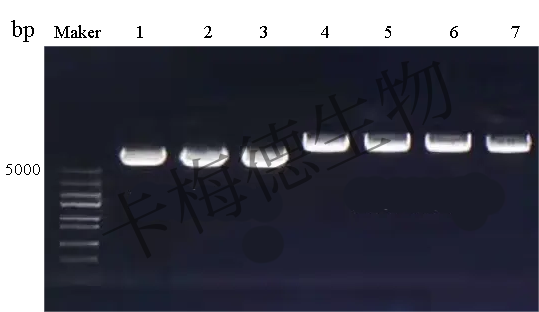
Figure 1: Gel image verifying vector linearization
V. KMD Bioscience Offers Recombinant Protein Yeast Expression Services
KMD Bioscience has been dedicated to recombinant protein expression and purification services for many years. We offer comprehensive recombinant protein yeast expression and purification services, including the pPICZaA, pGAPZaA, and pPIC9K expression vectors, as well as strains such as X33, GS115, and Saccharomyces cerevisiae.
- Eukaryotic expression
- recombinant protein yeast expression system
- yeast expression
- protein purification

- Protein Platform
- Protein Expression Services
- Protein Modification & Detection Services
- Protein Interaction Services
- Protein Purification Service
- Antibody Discovery Platform
- VHH Antibody Platform
- Phage Display Platform
- Antibody Humanization Platform
- Single B Cell Screening Platform
- Antibody Expression & Validation Platform
- Peptide Library Platform
- Custom Antibody Platform
- Innovative Drug Discovery Platform
- Product Center
- Proteins
- Antibodies
- Raw Materials Reagents
- Small Molecule Reagents
- Peptide Products
- Nanoparticle Products
- Contact Us
- Phone:400-621-6806
- Mobile:13110936064(WeC
- E-mail:[email protected]
- Address:Room 108, Building 10, No. 6 Hechang Road, Wuqing Development Zone, Tianjin City
-

WeChat
-

Service Account
-
 400-621-6806
 -
 3599163699
 -
 Monday to Friday 9:00-18:00
 -

-
 0
0
-
