


Methods for Validating the Affinity of Small-Molecule-Binding Aptamers
- 2026-01-20
- 312
In the field of biomedicine, small molecule aptamers play a significant role in targeted drug development due to their high specificity and strong binding affinity. During the screening process of small molecule aptamers selection, candidates must undergo rigorous affinity validation. Only those with ideal binding affinity can provide a foundation for subsequent drug development, making the selection of appropriate affinity validation methods crucial. Currently, Surface Plasmon Resonance (SPR) and Bio-Layer Interferometry (BLI) are two widely used and highly effective affinity detection techniques. They serve a core function in the verification step following small molecule aptamers selection.
I.Surface Plasmon Resonance (SPR) Technology
SPR technology is based on the phenomenon of surface plasmon resonance. It enables real-time, label-free detection of binding affinity between small molecules by measuring changes in the refractive index on the surface of a sensor chip during biomolecular interactions. In this process, the small molecule target is first immobilized on the sensor chip surface. Then, candidate aptamer solutions obtained from small molecule aptamers selection are continuously injected into the flow channels at varying concentrations. When the aptamers specifically bind to the targets on the chip surface, the refractive index changes. The instrument converts this change into an SPR response signal. By analyzing the signal curve, key affinity parameters such as the dissociation constant, association rate constant, and dissociation rate constant can be calculated.
SPR technology offers significant advantages for detecting the affinity of small molecule aptamers. It is highly sensitive and capable of precisely capturing weak interactions between low-concentration aptamers and their targets. This capability is crucial for assessing the affinity of early-stage candidate aptamers post-screening, effectively preventing potential setbacks in subsequent targeted drug development due to insufficient binding strength. Furthermore, the technology requires no labeling of the aptamers or targets, thereby minimizing potential disruptions to biomolecular activity caused by labeling procedures and ensuring that the results more accurately reflect interactions under natural conditions.
However, SPR technology also has certain limitations. It demands a more stringent detection environment, as impurities in the sample may interfere with the refractive index on the sensor chip surface and affect the accuracy of the results. Thus, samples must undergo rigorous purification before analysis, which, to some extent, increases both the operational complexity and time required for affinity validation of small molecule aptamers selection. Overall, SPR remains a vital method for conducting affinity validation following small molecule aptamer screening, providing precise affinity data to support targeted drug development.
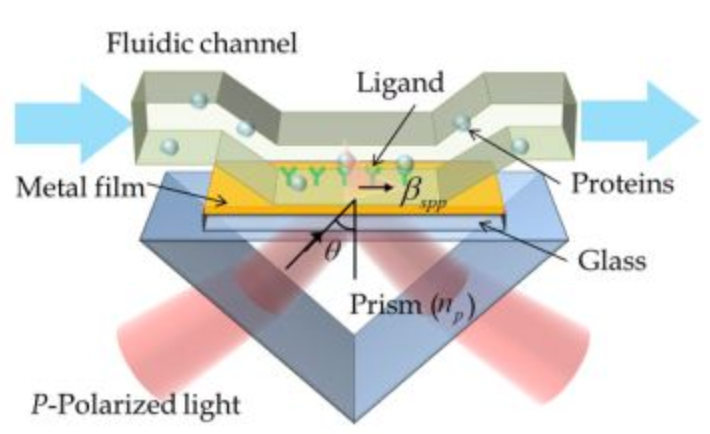
Figure 1 SPR Schematic Diagram
II.Bio-Layer Interferometry (BLI) Technology
BLI technology operates on the principle of bio-layer interferometry. It measures the affinity between biomolecules by monitoring the shift in the interference spectrum caused by changes in the thickness of the biological layer on the surface of a fiber optic biosensor tip. The operational procedure involves conjugating the small molecule target to the sensor tip. This tip is then immersed into a solution containing the candidate aptamers. When aptamers bind to the targets on the tip, the thickness of the biological layer on the tip surface increases, causing a shift in the interference spectrum. The instrument records this shift over time to generate association-dissociation curves. By fitting and analyzing the curves obtained from aptamer solutions at different concentrations, key affinity parameters between the aptamer and the target can be determined.
In the validation phase following small molecule aptamer screening, BLI technology demonstrates unique advantages. The technique is relatively straightforward to operate, requires minimal sample preprocessing, and consumes a small amount of sample during detection. This significantly reduces validation costs, making it suitable for the rapid preliminary screening of candidate aptamers and enhancing overall screening efficiency. BLI exhibits good resistance to interference and has lower sample purity requirements compared to SPR technology. It can perform accurate affinity measurements even in relatively complex sample matrices. This capability is highly valuable for assessing aptamer affinity under conditions that mimic a physiological environment during targeted drug development.
However, the sensitivity of BLI is slightly inferior to that of SPR. When detecting small molecule aptamers with very low affinity, optimizing experimental conditions may be necessary to improve detection accuracy. Despite this, BLI technology is widely applied in the field of small molecule aptamer affinity measurement. It provides a solid foundation for the efficient advancement of both small molecule aptamer screening and targeted drug development.
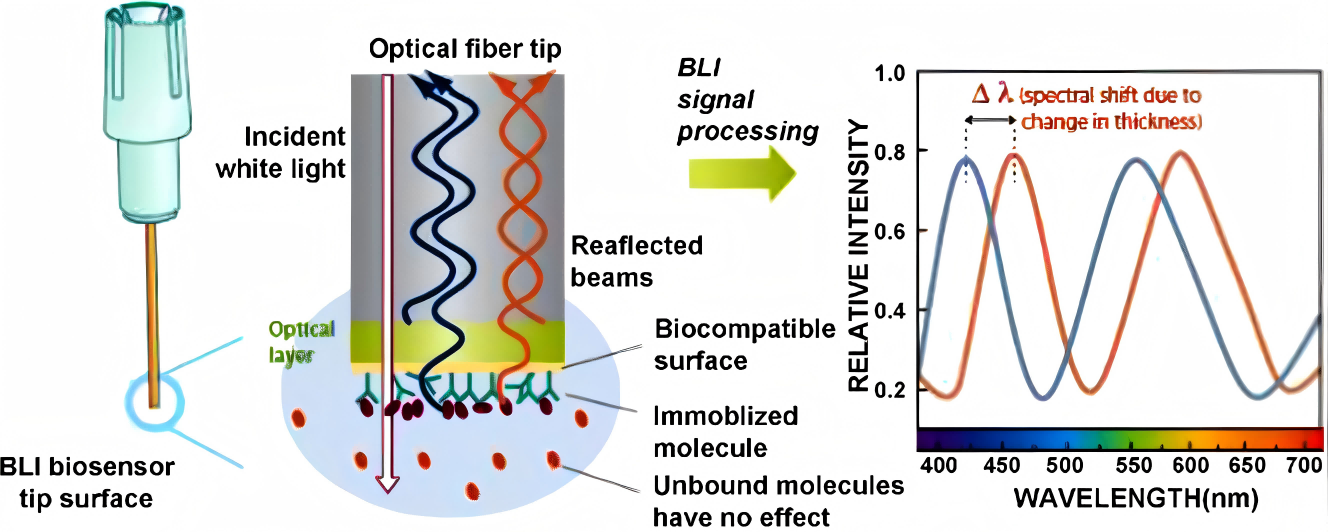
Figure 2 BLI Schematic Diagram
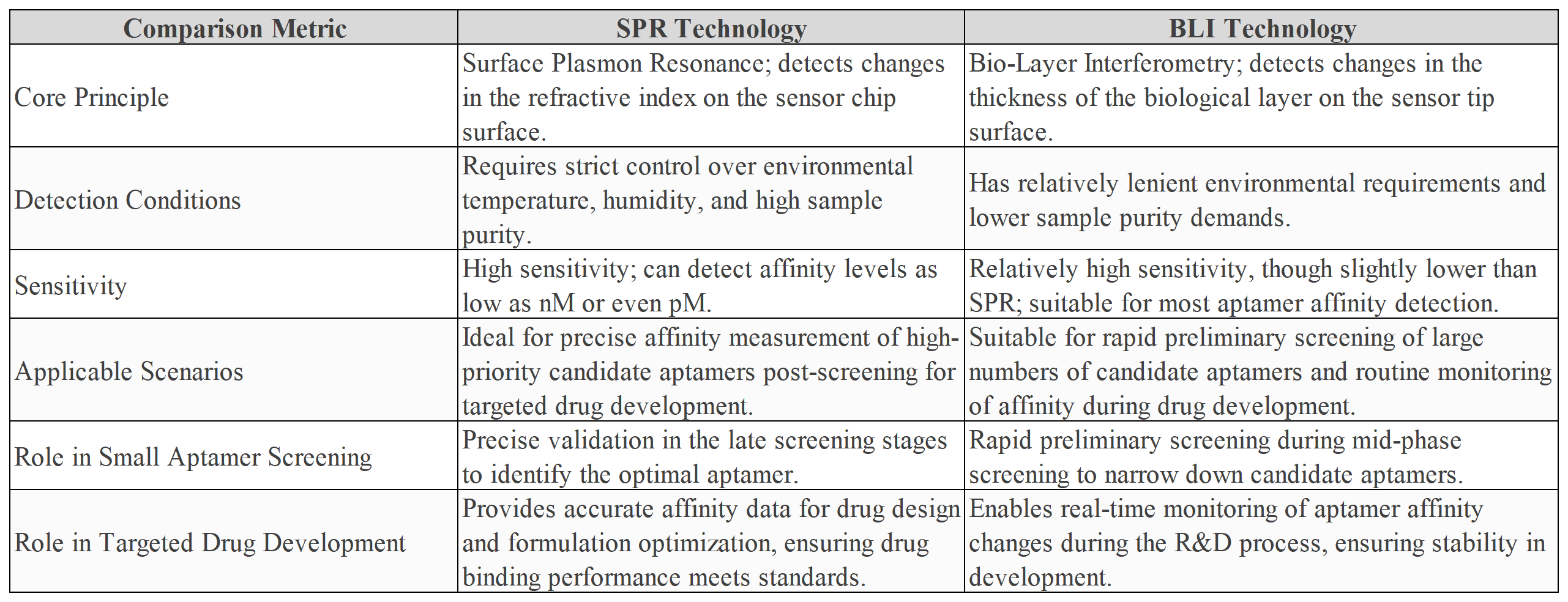
III.Comparative Analysis of SPR and BLI Technologies
[1] Roh S, Chung T, Lee B. Overview of the characteristics of micro- and nano-structured surface plasmon resonance sensors. Sensors (Basel). 2011;11(2):1565-88.
[2] Wallner J, Lhota G, Jeschek D, Mader A, Vorauer-Uhl K. Application of Bio-Layer Interferometry for the analysis of protein/liposome interactions. J Pharm Biomed Anal. 2013 Jan;72:150-4.
[3] Shitanda I, Oshimoto T, Loew N, et al. Biosensor development for low-level acetaldehyde gas detection using mesoporous carbon electrode printed on a porous polyimide film. Biosens Bioelectron. 2023 Oct 15;238:115555.
FAQ
1. When screening small molecule aptamers, if there are a large number of candidate aptamers (e.g., dozens), should SPR or BLI be prioritized for affinity validation?
BLI technology should be prioritized. From a practical application perspective, the core requirement when dealing with a large number of candidates is efficient down-selection rather than extreme precision. BLI is operationally simpler, requires no complex sample preprocessing, can process multiple samples simultaneously, and has low sample consumption—significantly reducing the time and cost per validation run. Using SPR would require stringent purification of each candidate aptamer, and its single-channel detection is inefficient; dozens of samples could take several days to process. After BLI identifies fewer than 10 high-potential aptamers through initial screening, SPR can then be used for precise parameter measurement. This approach better aligns with an "efficient + precise" screening logic.
2. SPR technology requires high sample purity. Does this limit its application in the early stages of aptamer screening (when candidate aptamer purity is low)?
This does impose certain limitations, but they can be partially mitigated by reasonably adjusting the experimental protocol. In the early stages of aptamer screening, candidate aptamers are often contaminated with unbound nucleic acid fragments, buffer impurities, etc. If SPR detection is used directly, these impurities can adhere to the sensor chip surface, interfering with the refractive index change signal and leading to deviations in Kd value calculations. However, the core objective of early-stage screening is a "preliminary assessment of whether binding affinity exists," not obtaining precise parameters. Therefore, the impact can be reduced through simplified optimization: for instance, performing a simple purification of the crude candidate aptamer extract instead of using high-purity chromatographic purification upfront. Simultaneously, using a higher concentration of the aptamer solution in the experiment can enhance the specific binding signal between the aptamer and the target, partially offsetting interference from impurities. It is important to note that SPR results at this stage should only serve as a "basis for preliminary screening," and preferred aptamers must still be purified and re-tested with precise detection later.
3. Both SPR and BLI can determine the dissociation constant (Kd). When interpreting the data, is it necessary to adjust the analysis model based on their differences in principle?
Yes, the analysis model must be adjusted according to the differences in principle; otherwise, data interpretationdeviation may occur. In principle, SPR is based on changes in the refractive index on the sensor chip surface, where the signal response has a direct linear relationship with the amount of aptamer-target binding. Therefore, the analysis model can directly use the "1:1 Langmuir binding model" without additional correction. In contrast, BLI is based on changes in the thickness of the biological layer on the fiber optic sensor tip. If the biological layer formed after aptamer-target binding is relatively thick, molecules within the layer may experience steric hindrance, preventing subsequent aptamers from binding easily. If the "1:1 model" is still used in this case, it will calculate an artificially high Kd value. The model should be adjusted to a "two-site binding model" or a "modified model accounting for steric hindrance" to better reflect the actual dynamics of the biological layer thickness change. Furthermore, in SPR detection, the refractive index is significantly affected by temperature, so a temperature correction parameter must be incorporated during data analysis. BLI is less affected by temperature, allowing this step to be omitted. Only by adjusting the model according to the principle differences can the accuracy of Kd value interpretation be ensured.
4. During the mid-to-late stages of targeted drug development, the stability of aptamer affinity needs to be repeatedly validated. What are the specific advantages of using BLI technology for this purpose?
The core requirements for repeated validation in the mid-to-late stages are "efficiency, low cost, and stable monitoring." BLIprecisely meets these needs:
Low operational barrier: It does not require specialized personnel to frequently adjust the environment.Conventional lab personnel can perform the detection after simple training, making it suitable for high-frequency operations.
Low sample processing cost: Although aptamers are purified in the mid-to-late stages, cost control remains important for repeated testing. BLI's sample consumption is only 1/5 to 1/3 of SPR's, and it does not require replacing expensive sensor chips for each run, leading to significant long-term savings on consumables.
Fast data feedback: The BLI detection cycle is short, enabling real-time monitoring of aptamer affinity changes across different R&D stages. If a decrease in affinity is detected, the problem can be quickly traced back, ensuring the R&D process proceeds stably.
- biomolecular interaction
- small molecule aptamer
- aptamer selection
- binding affinity

- Protein Platform
- Protein Expression Services
- Protein Modification & Detection Services
- Protein Interaction Services
- Protein Purification Service
- Antibody Discovery Platform
- VHH Antibody Platform
- Phage Display Platform
- Antibody Humanization Platform
- Single B Cell Screening Platform
- Antibody Expression & Validation Platform
- Peptide Library Platform
- Custom Antibody Platform
- Innovative Drug Discovery Platform
- Product Center
- Proteins
- Antibodies
- Raw Materials Reagents
- Small Molecule Reagents
- Peptide Products
- Nanoparticle Products
- Contact Us
- Phone:400-621-6806
- Mobile:13110936064(WeC
- E-mail:[email protected]
- Address:Room 108, Building 10, No. 6 Hechang Road, Wuqing Development Zone, Tianjin City
-

WeChat
-

Service Account
-
 400-621-6806
 -
 3599163699
 -
 Monday to Friday 9:00-18:00
 -

-
 0
0
-
