


Methods, Challenges, and Advantages of Constructing Stable Cyclic Heptapeptide Libraries
- 2026-07-08
- 375
I. Overview
A cyclic heptapeptide library refers to a molecular collection comprising a vast number of heptapeptide sequences rendered into circular structures via covalent linkage, either head-to-tail or side chain-mediated, using combinatorial chemistry and molecular biology methods. Linear peptides suffer from inherent drawbacks in biological systems, such as conformational flexibility, susceptibility to rapid proteolytic degradation, and poor cell membrane permeability. Cyclization addresses these limitations by introducing covalent constraints that lock the peptide chain into specific low-energy conformational states, significantly enhancing structural rigidity. This confers tremendous potential for both pharmaceutical research and fundamental biological studies.
Introducing a cyclic structure can directly enhance the peptide's affinity and specificity for target binding. It mimics rigid loop domains found at protein-protein interaction interfaces while also protecting the N- and C-termini from exopeptidase cleavage. Consequently, employing cyclic heptapeptides as molecular libraries for high-throughput screening facilitates the rapid discovery of high-activity, high-selectivity, drug-like lead compounds targeting various disease targets. This approach exhibits unique advantages, particularly for modulating protein-protein interactions (PPIs), which are often challenging for traditional small molecules to address.
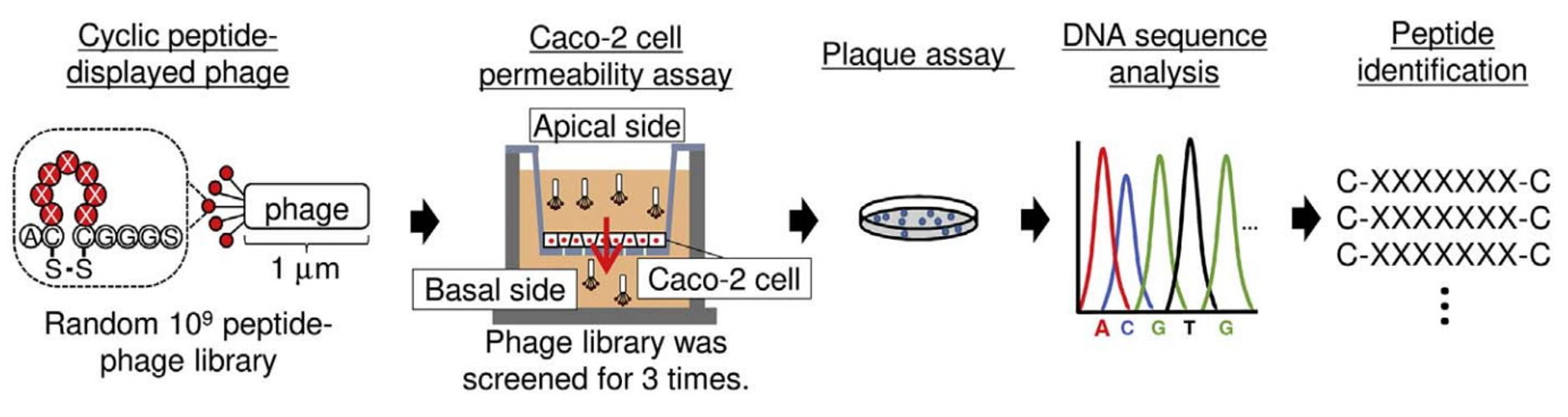
Flowchart of High-Throughput Screening for Cyclic Heptapeptides (Adapted from [1])
II. Principles of Cyclic Heptapeptide Library Construction
Heptapeptide cyclization involves creating a macrocyclic structure via a covalent bond between two specific sites within the peptide chain, achieved through chemical or enzymatic methods. This requires precise control over the cyclization sites and efficiency. In principle, cyclization is primarily categorized into three types:
Head-to-Tail Cyclization: This most common method forms an amide bond between the N-terminal amino group and the C-terminal carboxylic acid. It typically requires full side-chain protection during solid-phase peptide synthesis (SPPS) and employs specific coupling reagents in dilute solutions to favor intramolecular cyclization over intermolecular polymerization.
Side Chain-to-Side Chain Cyclization: This utilizes functional groups on the side chains of two amino acid residues to form the cyclic structure. Examples include forming a highly rigid disulfide bond between two cysteine (Cys) residues, or creating an amide bond between the side chain amino group of a lysine (Lys) and the side chain carboxylic acid of an aspartic acid (Asp) or glutamic acid (Glu) residue.
Head/Tail-to-Side Chain Cyclization: This involves connecting a terminal end of the peptide chain (N- or C-terminus) to a functional group on a side chain.From a conformational entropy perspective, a linear peptide samples a vast number of possible conformations in solution. Cyclization, enforced by the covalent bond, restricts it to one or a few predominant conformations, drastically reducing the system's entropy. This conformational pre-organization means the cyclic peptide does not pay a significant entropy penalty upon binding its target, resulting in higher binding free energy and greater affinity.
III. Methods for Constructing Cyclic Heptapeptide Libraries
The construction of cyclic heptapeptide libraries is a complex process integrating synthetic chemistry and biotechnology. The primary strategies can be divided into chemical synthesis followed by cyclization and in vivo biological cyclization.
Chemical Synthesis Strategy: This typically relies on the "One-Bead-One-Compound" (OBOC) combinatorial library technology:
A library of linear heptapeptides is synthesized randomly on millions of microbeads via solid-phase peptide synthesis (SPPS), with each bead carrying a uniform peptide sequence.
The linear peptides, either still anchored to the resin or after cleavage, undergo solution-phase cyclization. This process requires optimization of solvent, concentration, coupling reagents, and temperature to maximize intramolecular cyclization product formation while minimizing dimer or polymer byproducts. For libraries containing cysteine, oxidative conditions can be applied to form disulfide bonds.
In Vivo Biological Cyclization Strategy: This primarily utilizes phage display or mRNA display technologies:
In phage display, a DNA library encoding random heptapeptides is cloned into a gene of the phage coat protein, resulting in each phage particle displaying a unique linear heptapeptide on its surface.
Genetic engineering is used to introduce cyclization tags, recognized by specific enzymes, flanking the peptide sequence.
By adding the corresponding enzyme, efficient and specific cyclization of the peptide chain is catalyzed either on the surface of living cells or in vitro. This creates a vast cyclic peptide library with a direct genotype-to-phenotype linkage, facilitating subsequent functional screening through multiple rounds of "biopanning" (adsorption-wash-elution- amplification).
IV. Advantages
Compared to linear peptide libraries, cyclic heptapeptide libraries offer comprehensive and decisive advantages, primarily manifested in structural stability, bioactivity, and drug-like properties:
Structural Stability: The cyclic structure eliminates vulnerable terminal and enhances the rigidity of the peptide backbone, conferring superior resistance to proteolytic hydrolysis in plasma and tissues, thereby resulting in a longer in vivo half-life.
Bioactivity: The "conformational pre-organization" effect, resulting from the conformational constraint, allows cyclic heptapeptides to precisely complement the high-affinity binding pocket of a target protein without undergoing significant conformational rearrangement. This not only substantially increases binding affinity but also greatly enhances target specificity, enabling effective discrimination between structurally similar targets and reducing off-target effects.
Drug-like Properties: Although the molecular weight of a heptapeptide is slightly higher than traditional small molecules, cyclization can form more compact, globular structures. Some cyclic peptides can even penetrate cell membranes or the blood-brain barrier, expanding their application scope. Furthermore, cyclic heptapeptide libraries constructed via phage display enable the direct selection of lead compounds with high binding affinity for complex targets from billions of candidates, significantly accelerating the drug discovery process.
V. Challenges
1.Cyclization Efficiency and Byproduct Control: Forming a seven-membered ring in heptapeptides involves inherent ring strain, and intramolecular cyclization competes with intermolecular polymerization. Particularly in chemical cyclization, reaction conditions are extremely stringent, making it difficult to ensure all sequences form a single, correct cyclic product in high yield. This leads to the actual diversity of functional cyclic peptides in the library being much lower than the theoretical value.
2.Conformational Homogeneity: Not all cyclic heptapeptides adopt a single conformation. Some sequences may transition between different conformational states or form unintended topological isomers after cyclization, increasing background noise in functional screens.
3.Membrane Permeability and Oral Bioavailability: While the introduction of the cyclic structure significantly enhances the stability of heptapeptide libraries, the lack of mature design principles for reliably identifying sequences capable of efficient cell membrane penetration remains a current limitation.
4.KMD Bioscience leverages its advanced phage display platform to construct cyclic heptapeptide libraries with a capacity of up to 1013/mL. Using biopanning methods, we identify high-affinity cyclic heptapeptide sequences, demonstrating significant utility in peptide drug development and epitope mapping studies. We offer integrated services spanning from cyclic heptapeptide library construction and specificity screening to affinity validation, meeting our clients' needs for developing high-quality lead compounds and fully supporting your innovative drug discovery and life science research.
[1] Yamaguchi S, Ito S, Kurogi-Hirayama M, Ohtsuki S. Identification of cyclic peptides for facilitation of transcellular transport of phages across intestinal epithelium in vitro and in vivo. J Control Release. 2017;262:232-238.
[2] Yamaguchi S, Ito S, Masuda T, Couraud PO, Ohtsuki S. Novel cyclic peptides facilitating transcellular blood-brain barrier transport of macromolecules in vitro and in vivo. J Control Release. 2020;321:744-755.
[3] Wang L, Fu Z, Su Y, et al. Cyclic Heptapeptide FZ1 Acts as an Integrin αvβ3 Agonist to Facilitate Diabetic Skin Wound Healing by Enhancing Angiogenesis. J Med Chem. 2025;68(18):19503-19520.
FAQ
Q1: Why do cyclic heptapeptide libraries show greater potential than linear peptide libraries for targeting protein-protein interactions (PPIs)?
A: Protein-protein interaction (PPI) interfaces are typically broad, flat, and lack deep binding pockets, making them difficult targets for traditional small molecules. Linear peptides, while capable of mimicking protein binding fragments, suffer from high flexibility leading to significant entropic penalty upon binding and are prone to proteolytic degradation. Cyclic heptapeptides address these limitations through conformational constraint introduced by cyclization, which mimics the rigid structure and spatial orientation of key binding motifs (such as α-helices and β-turns) found in native PPIs. This allows them to form high-affinity interactions with flat PPI interfaces with lower entropic loss.
Furthermore, the cyclic structure enables optimal pharmacophore distribution, facilitating simultaneous interactions with multiple dispersed "hot spot" residues on the target interface, thereby generating substantial binding energy. Additionally, the incorporation of non-natural amino acids via combinatorial chemistry introduces physicochemical properties superior to natural side chains, further expanding the diversity of available binding interactions. This enhances the probability of discovering potent and highly selective inhibitors capable of effectively competing with and inhibiting specific PPIs, establishing cyclic heptapeptide libraries as a powerful tool for exploring these challenging targets.
Q2: What are the primary cyclization strategies used to construct cyclic heptapeptide libraries, and what are their respective applications/considerations?
A: The construction of cyclic heptapeptide libraries primarily relies on site-specific cyclization strategies, with the core methods being head-to-tail cyclization and side chain-to-side chain cyclization:
1) Head-to-Tail Cyclization: This method involves forming an amide bond between the peptide's N-terminal amino group and C-terminal carboxylic acid. It produces structures most similar to natural cyclic peptides, maximizes backbone rigidity, and enhances metabolic stability. However, it demands stringent sequence design and synthesis conditions and carries a risk of oligomerization or racemization.
2)Side Chain-to-Side Chain Cyclization: This strategy utilizes functional groups on amino acid side chains. Examples include forming a disulfide bond between the thiol groups of two cysteine residues, or creating a lactam bridge between the ε-amino group of a lysine and the carboxylic acid group of an aspartic acid or glutamic acid residue. Disulfide bond cyclization is readily achieved under oxidative conditions but may be unstable in reducing physiological environments. In contrast, the lactam bridge offers a cyclization mode that is generally more stable under physiological conditions.
Q3: How does cyclization enhance the metabolic stability and cell membrane permeability of heptapeptides?
A: 1) Regarding Metabolic Stability: Cyclization eliminates the N- and C-termini of linear peptides, which are primary recognition and cleavage sites for exopeptidases. Concurrently, cyclization constrains the conformational flexibility of the peptide backbone, reducing the accessibility of cleavage sites to endopeptidases. This significantly extends their half-life in biological systems.
2) Regarding Cell Membrane Permeability: Linear peptides struggle to penetrate the lipid bilayer due to their high flexibility and exposed polar backbone and charged side chains. Cyclization forces the peptide into a more compact conformation. This can bury polar amide bonds within the molecular interior or neutralize their polarity through intramolecular hydrogen bonding networks, while also promoting the clustering of hydrophobic side chains to form a continuous hydrophobic surface. This conformational pre-organization and the formation of a "hydrophobic mask" lower the overall desolvation penalty, thereby promoting passive transmembrane transport.
Q4: What are the unique advantages of cyclic heptapeptide libraries in drug screening?
A: 1) Conformational Constraint: The primary advantage is conformational restriction. Cyclization pre-organizes library members into specific three-dimensional structures, drastically reducing the entropic penalty required for target binding. This generally results in higher target affinity and binding specificity compared to linear peptides, enabling effective discrimination between structurally similar target homologs.
2) Inherent Metabolic Stability and Potential Membrane Permeability: These properties mean that positive hits identified from such libraries possess superior drug-like characteristics, directly increasing the success rate of converting hits into viable lead compounds.
3) Vast Chemical Space: Constructing cyclic heptapeptides using non-natural amino acids allows exploration of structural diversity far beyond the limitations of natural amino acids. This holds promise for targeting protein-protein interaction interfaces traditionally considered "undruggable."
Q5: What are the key application scenarios for cyclic heptapeptide libraries in biomedicine and basic research?
A: 1) Primary Application: Developing Innovative PPI Therapeutics: Cyclic heptapeptide libraries are particularly suited for inhibiting protein-protein interactions. For instance, they can be screened to identify potent inhibitors targeting interactions like p53-MDM2 in cancer, inflammatory signaling pathways, or specific GPCRs, providing novel mechanism-based drug candidates for diseases such as cancer and autoimmune disorders.
2) Tools for Cellular Function Modulation: Selected cyclic heptapeptides can serve as cell-penetrating peptides for specifically disrupting intracellular signal transduction, regulating gene expression, or inducing protein degradation. Their superior stability and membrane permeability make them more effective functional probes than linear peptides or siRNA for deciphering complex cell biological processes.
3) Diagnostics and Molecular Imaging Tools: Cyclic heptapeptides can act as high-affinity, high-stability ligands for developing novel imaging agents or biosensors that target specific disease biomarkers.
- peptide phage display
- bioactive peptides discovery
- next-generation sequencing
- peptide libraries

- Protein Platform
- Protein Expression Services
- Protein Modification & Detection Services
- Protein Interaction Services
- Protein Purification Service
- Antibody Discovery Platform
- VHH Antibody Platform
- Phage Display Platform
- Antibody Humanization Platform
- Single B Cell Screening Platform
- Antibody Expression & Validation Platform
- Peptide Library Platform
- Custom Antibody Platform
- Innovative Drug Discovery Platform
- Product Center
- Proteins
- Antibodies
- Raw Materials Reagents
- Small Molecule Reagents
- Peptide Products
- Nanoparticle Products
- Contact Us
- Phone:400-621-6806
- Mobile:13110936064(WeC
- E-mail:[email protected]
- Address:Room 108, Building 10, No. 6 Hechang Road, Wuqing Development Zone, Tianjin City
-

WeChat
-

Service Account
-
 400-621-6806
 -
 3599163699
 -
 Monday to Friday 9:00-18:00
 -

-
 0
0
-
