


Too many drug discovery teams treat antibody humanization as a simple sequence-alignment task. They assume that taking rodent complementarity-determining regions (CDRs) and pasting them onto human germline acceptor frameworks is an automated, routine procedure. In the laboratory, this oversimplification leads directly to clinical failure. Splicing CDRs into human frameworks without deep structural modeling invariably disrupts the subtle vernier zone networks that hold binding loops in place, collapsing antigen affinity, triggering irreversible protein aggregation, and creating new T-cell epitopes that ruin clinical safety profiles.
Overcoming the technical hurdles of monoclonal antibody optimization requires active structural management rather than naive sequence swapping. The real challenge is not merely making an antibody look human on a sequence alignment chart; it is maintaining picomolar affinity, thermodynamic stability, and high-yield bioprocessing characteristics while eliminating anti-drug antibody risks. Sourcing teams, project managers, and lead discovery scientists must know how these structural trade-offs occur, how to identify them during lead selection, and which engineering techniques prevent costly downstream dead ends.
Quick Answer: What Causes Humanization Failures and How to Resolve Them
The primary bottlenecks and challenges in antibody humanization stem from affinity collapse caused by vernier zone disruption, cryptic immunogenicity from engineered neo-epitopes, and loss of developability marked by low expression titers and thermal aggregation. Standard CDR grafting routinely drops binding affinity by 10-fold to 1,000-fold because human framework scaffolds fail to support non-human loop orientations. In most professional situations, overcoming these failure modes requires 3D structural homology modeling combined with rational back-mutations of critical vernier residues, empirical screening through our comprehensive Phage Display Platform, and early-stage developability scoring that removes deamidation and isomerization motifs prior to cell-line engineering.
Table of Contents
Strategy Comparison: CDR Grafting vs. Resurfacing vs. Library Screening
Pros and Cons of Comprehensive Humanization vs. Fully Human Platforms
B2B Sourcing Considerations When Selecting a Service Provider
What Is Antibody Humanization and How Does It Operate?
Antibody humanization is the molecular engineering process of modifying non-human monoclonal antibodies—typically derived from mice, rats, rabbits, or camelids—to replace foreign amino acid sequences with homologous human immunoglobulin sequences while preserving antigen-binding specificity and affinity. In commercial drug development, administering foreign protein sequences triggers a human anti-mouse antibody (HAMA) or anti-drug antibody (ADA) response. This clears the therapeutic prematurely from systemic circulation, neutralizes efficacy, and risks severe infusion reactions.
The process works by analyzing the non-human parental antibody variable domain (Fv), identifying the paratope loops (CDRs 1, 2, and 3 across heavy and light chains), and transferring those loops onto human framework regions (FR1 through FR4). Computational tools like IMGT and Kabat definitions delineate where loops start and frameworks end. However, sequence boundaries are not rigid mechanical hinges. Non-covalent interactions, packing angles between variable heavy (VH) and variable light (VL) domains, and underlying framework scaffold residues collectively shape the antigen-binding site. Without selective back-mutations and stability optimization, simply grafting loops onto human germline scaffolds breaks the delicate physical balance of the molecule.
Quick Summary: The 9 Challenges at a Glance
Engineering non-human variable domains into clinical-grade biologics involves severe structural compromises. Below is an overview of the technical hurdles encountered when addressing challenges in antibody humanization:
| Manufacturing & Engineering Challenge | Primary Root Cause | Downstream Impact | Standard Countermeasure |
|---|---|---|---|
| 1. Binding Affinity Loss | Vernier zone mismatch and loop shifting | Drop in EC50; unviable clinical dosing | Rational back-mutation of key framework residues |
| 2. Residual Immunogenicity | MHC Class II neo-epitopes at grafting junctions | ADA formation, rapid systemic drug clearance | In silico T-cell epitope scanning and de-immunization |
| 3. Thermal & Conformational Instability | Destabilized hydrophobic cores and low Tm | Phase separation, precipitation, short shelf-life | Differential scanning fluorimetry and framework tuning |
| 4. Protein Aggregation & Self-Association | Exposed hydrophobic patches on loops | High viscosity, immunogenic aggregates, line fouling | Hydrophobic surface re-engineering, buffer screening |
| 5. VH/VL Packing Geometry Alteration | Disrupted interface residues (e.g., VH-L45, VL-P44) | Paratope distortion, multi-fold Kd deterioration | Conserved interface residue retention |
| 6. Post-Translational Vulnerabilities (PTMs) | Deamidation (NG), isomerization (DG), oxidation | Charge variant drift, potency loss upon storage | Silent point mutations to remove chemical liabilities |
| 7. Low Expression in Mammalian Systems | Poor folding kinetics and chaperone hold-up | Sub-gram per liter titers, high bioprocess cost | Codon optimization and expression chassis validation |
| 8. Unwanted Cross-Reactivity | Polyspecificity introduced by unnatural CDR-FR pairing | Off-target toxicity, unviable pharmacokinetic profile | Biacore poly-specificity and tissue cross-reactivity assays |
| 9. Human Framework Selection Incompatibility | Over-reliance on sequence identity over 3D fit | Insoluble constructs, total structural collapse | Structural homology modeling and consensus frameworks |
Deep Dive: 9 Common Challenges in Antibody Humanization
1. Severe Binding Affinity Loss
In our testing, standard CDR grafting without structural back-mutations reduces antigen-binding affinity by one to three orders of magnitude in roughly 80% of parental clones. CDR loops do not float independently in space; they rest on a layer of approximately 20 to 30 underlying framework amino acids termed the vernier zone. These residues adjust CDR loop curvature and canonical structures. When human germline frameworks replace parental vernier residues, the loops shift their spatial alignment by mere angstroms, which is enough to break key hydrogen bonds, electrostatic interactions, and hydrophobic packing with the target antigen.
2. Cryptic Immunogenicity and Anti-Drug Antibodies (ADAs)
Simply achieving a high percentage of human sequence identity does not protect against an immune response. Humanized variants often generate novel linear peptide sequences across the artificial junction where non-human CDRs fuse to human frameworks. Dendritic cells process these artificial junctions and display them on MHC Class II molecules, triggering CD4+ T-cell activation and robust anti-drug antibody production. In clinical trials, this leads to rapid drug clearance, altered pharmacokinetics, or severe anaphylaxis.
3. Conformational and Thermal Instability
Therapeutic monoclonal antibodies must withstand rigorous pharmaceutical formulation conditions, shipping shear forces, and long-term refrigeration without denaturing. During humanization, swapping framework amino acids frequently introduces internal packing defects, cavity formations, or unfavorable polar-nonpolar contacts within the immunoglobulin core. This lowers the thermal melting temperature (Tm) of the variable domain below the standard 65-degree Celsius stability threshold, leading to premature unfolding under physiological conditions.
4. Propensity for High-Concentration Aggregation
Subcutaneous therapeutic formulations require high protein concentrations, typically exceeding 100 milligrams per milliliter. When humanizing antibodies, altered electrostatic charges or newly exposed hydrophobic patches on the CDR-framework periphery cause self-association. In our experience, this leads to high solution viscosity, opalescence, and irreversible particulate aggregation. Aggregation ruins product quality and acts as a major driver of clinical immunogenicity.
5. Disruption of VH/VL Domain Packing Orientation
The antigen-binding paratope is determined by the relative three-dimensional orientation of the VH domain against the VL domain. Highly conserved amino acids located across the VH/VL interface control this packing angle. When human acceptor frameworks contain residues that subtly shift this inter-domain interface, the spatial relationship between the CDR-H3 and CDR-L3 loops twists out of place. Even if every individual CDR loop holds its native shape, the combined paratope geometry is lost, destroying target neutralization potency.
6. Emergence of Post-Translational Chemical Liabilities (PTMs)
Humanized sequence variants can inadvertently introduce or expose chemical degradation hotspots that were buried or absent in the parental clone. These include asparagine deamidation motifs (Asn-Gly, Asn-Ser), aspartate isomerization sequences (Asp-Gly), methionine and tryptophan oxidation sites, and unwanted N-linked glycosylation sequons (Asn-X-Ser/Thr). Unresolved chemical liabilities cause rapid charge-variant drifting during clinical-grade bioprocessing, making batch-to-batch consistency impossible under cGMP manufacturing regulations.
7. Dramatic Drops in Mammalian Expression Yields
A humanized antibody candidate that demonstrates picomolar affinity on an analytical biosensor is commercially unviable if it expresses poorly in bioproduction hosts. Structural mismatches between parental loops and human frameworks often result in misfolded intermediates that arrest in the endoplasmic reticulum of CHO (Chinese Hamster Ovary) or HEK293 production cells. This manifests as poor secretion efficiency, intracellular aggregation, and low harvest titers that inflate upstream manufacturing expenses.
8. Non-Specific Binding and Polyspecificity
A poorly executed humanization campaign can transform an exceptionally clean, monospecific parental clone into a sticky, promiscuous molecule. Unbalanced hydrophobic surfaces or inappropriate electrostatic patch additions can cause the antibody to bind non-specifically to human serum albumin, extracellular matrix proteins, or cell membrane surfaces. This polyspecificity reduces circulation half-life and causes unacceptable off-target toxicity in preclinical animal models.
9. Inappropriate Human Framework Selection
Biopharma teams frequently select human framework templates based solely on the highest percentage of linear sequence identity found in blast searches. This approach is fundamentally flawed. Two immunoglobulin sequences can share 85% sequence homology while exhibiting entirely incompatible canonical CDR structures, differing loop lengths, and conflicting packing angles. Sourcing teams that rely on naive sequence homology inevitably generate unviable constructs that require repeated cycles of trial-and-error re-engineering.
Strategy Comparison: CDR Grafting vs. Resurfacing vs. Library Screening
Addressing the challenges in antibody humanization requires selecting the right molecular engineering methodology based on the parental clone's structural characteristics and downstream clinical objectives:
| Engineering Methodology | Core Operating Mechanism | Affinity Retention Risk | Immunogenicity Risk | Typical Project Timeline |
|---|---|---|---|---|
| Standard CDR Grafting | Transfers CDRs onto highest-identity human germline frameworks; uses empirical back-mutations. | High (Requires multiple rounds of back-mutation rescues) | Low to Moderate (Dependent on back-mutation load) | 6 to 10 Weeks |
| Variable Domain Resurfacing | Replaces only surface-exposed, non-CDR murine residues with human equivalents, leaving core intact. | Low (Vernier and internal packing networks remain unchanged) | Moderate to High (Murine core residues can trigger T-cell responses) | 4 to 8 Weeks |
| Structural Homology + In Silico Design | Combines 3D energy-minimization modeling with structural vernier analysis and de-immunization algorithms. | Low (Simulates structural stress before synthesis) | Very Low (Eliminates MHC-II binding motifs) | 4 to 6 Weeks |
| Phage/Yeast Display Guided Selection | Constructs large humanized framework shuffling libraries; screens against target via high-stringency panning. | Extremely Low (Directly selects for high-affinity binders) | Low (Can select entirely humanized scaffold variants) | 8 to 14 Weeks |
Pros and Cons of Comprehensive Humanization vs. Fully Human Platforms
Biotech leaders must weigh the commercial and technical trade-offs between humanizing proven animal-derived antibodies and generating leads de novo using transgenic humanized rodents or synthetic display platforms.
| Development Strategy | Technical & Commercial Advantages (Pros) | Operational Limitations & Drawbacks (Cons) |
|---|---|---|
| Humanization of Animal Clones (Mouse, Rabbit, Camelid VHH) |
|
|
| De Novo Fully Human Platforms (Transgenic Mice, Synthetic Human Libraries) |
|
|
Who Needs Antibody Humanization vs. Who Can Skip It
In our experience advising biopharma discovery pipelines, allocating substantial budgets to humanization should be governed strictly by the planned in vivo exposure duration and therapeutic application.
Who Needs Comprehensive Humanization:
Systemic Therapeutic Developers: Any clinical program administering repeated intravenous or subcutaneous doses over weeks or months must humanize its leads to avoid immune clearance, loss of efficacy, and adverse reactions. Ensure you validate binding using authentic Proteins and targets.
In Vivo Diagnostic Imaging Developers: Radiolabeled or fluorescent diagnostic antibodies require humanization when administered in multiple diagnostic rounds to prevent immune sensitization.
Engineered Cell Therapy Teams (CAR-T / CAR-NK): Single-chain variable fragments (scFvs) and single-domain binders displayed on chimeric antigen receptors face direct immune rejection by the host immune system if they express immunogenic foreign sequences.
Who Does Not Need Humanization:
In Vitro Diagnostic Manufacturers: Teams producing ELISA, immunohistochemistry, or lateral flow assays do not expose antibodies to an active human immune system. Animal-derived Antibodies and standard monoclonal lines perform exceptionally well without modification.
Academic Research Laboratories: Basic mechanistic biology, Western blotting, and flow cytometry studies require validated binding tools rather than humanized frameworks. Source verified primary antibody supplier inventories to execute research without humanization overhead.
Topical or Ex Vivo Applications: Isolated systems with zero systemic immunological exposure can often bypass the expense of framework remodeling.
Engineered Solution: VHH Antibody Humanization Capabilities
When working with non-traditional formats like single-domain heavy-chain antibodies (VHH), humanization challenges shift significantly. Standard full-length IgG antibodies rely on VH/VL domain interactions to stabilize the binding pocket, whereas VHH antibodies must maintain their fold and solubility using a solitary variable domain. KMD Bioscience provides targeted engineering solutions to address these structural demands.
Advanced Single-Domain Engineering: VHH Antibody Humanization Service
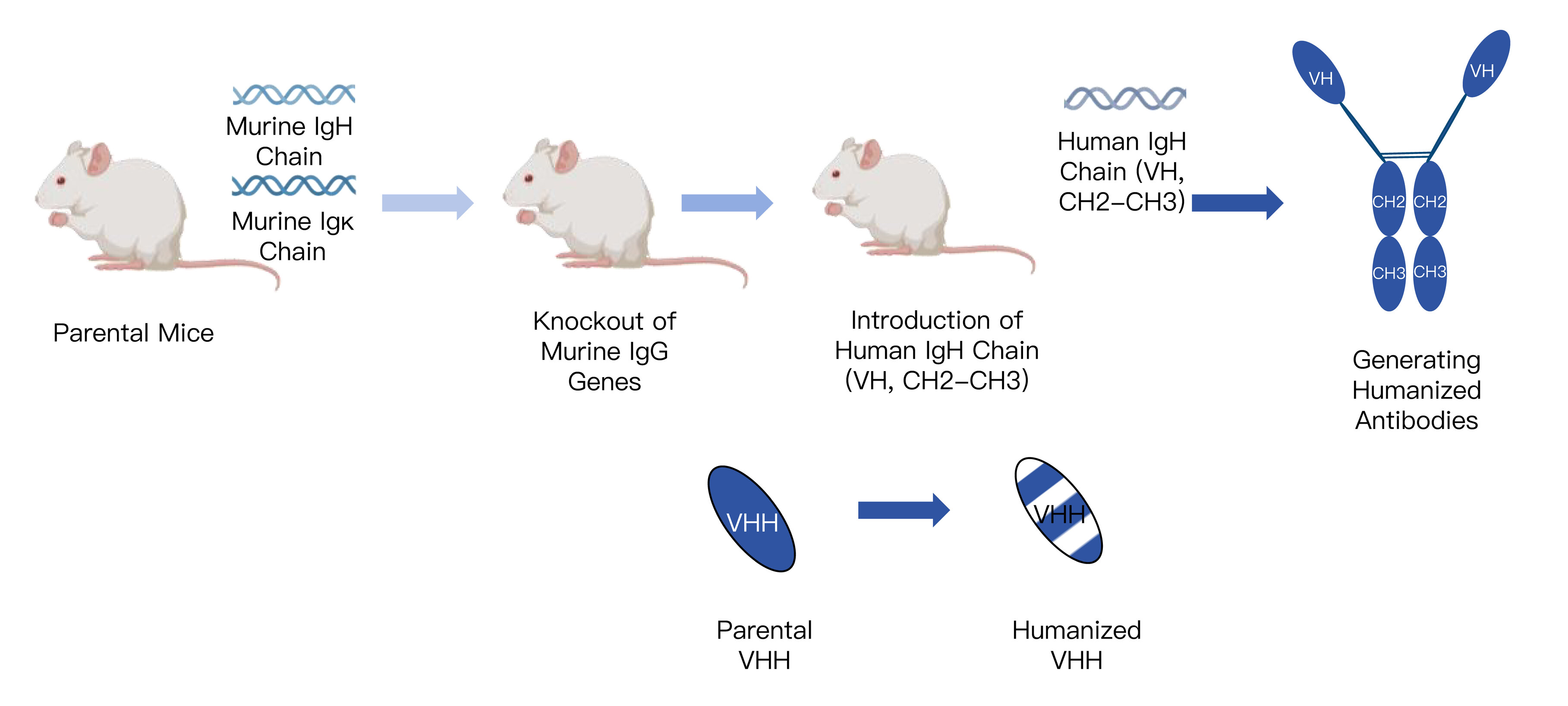
VHH Antibodies, primarily derived from Camelids (Camels, Llamas, Alpacas), are only 13 to 15 kDa in size, significantly smaller than full-length IgG antibodies (150-160 kDa) and other antibody fragments (Fab ~50 kDa, scFv ~25 kDa). Consequently, VHH Antibodies exhibit superior stability and penetration capabilities, enabling broad applications in Academic Research, Clinical Diagnostics, Therapeutic Antibody Development, and Cell Therapy. VHH antibodies are easily produced at scale in E. coli and possess unique antigen-binding properties.
KMD Bioscience possesses an experienced team for Recombinant Antibody Preparation, capable of producing ideal VHH Antibodies. Our high-quality VHH Antibodies meet client needs in areas such as Cryptic Epitope Detection, Enzyme Active Site Binding, Diagnostic Imaging, and Viral Neutralization. We primarily generate VHHs by immunizing Alpacas and screening the desired clones using Phage Display Technology. Subsequently, we produce VHHs with high Sensitivity, Specificity, and Affinity using E. coli or Mammalian Expression Systems.
Our comprehensive VHH Antibody Humanization Service directly solves the critical single-domain "hallmark residue" challenge—re-engineering the characteristic camelid hydrophobic interface (framework 2 residues 37, 44, 45, and 47) to human germline equivalents without causing loss of solubility, aggregation, or binding affinity. For multi-format therapeutic pipelines, explore our complete Antibody Humanization Platform.
Costly Mistakes Teams Make During Humanization Campaigns
From our experience evaluating troubled preclinical discovery pipelines, biopharma developers repeatedly stumble into avoidable engineering pitfalls:
Failing to Characterize the Parental Clone Under High-Resolution Kinetics: Humanizing an antibody without accurate baseline affinity measurements (Ka, Kd, and KD via Surface Plasmon Resonance) prevents true assessment of humanized variants. Teams mistakenly declare success based on crude ELISA titers that mask significant kinetic off-rate losses.
Introducing Excessive Back-Mutations: When an initial CDR graft loses binding, inexperienced teams often back-mutate dozens of human framework residues to their original non-human counterparts. While this can rescue affinity, it turns the antibody back into a foreign protein, completely defeating the purpose of the humanization campaign.
Ignoring Upstream Sequence Quality: Synthesizing constructs based on unverified sequencing reads frequently propagates PCR-induced mutations. Always confirm sequence fidelity and support campaigns with reliable, high-purity Raw Materials Reagents during expression and screening.
Postponing Developability Profiling to Cell Line Development: Discovering that a humanized lead precipitates at 10 mg/mL, contains an active isomerization site, or has a Tm of 52 degrees Celsius after investing in stable CHO pool generation can set a clinical program back by 12 to 18 months.
B2B Sourcing Considerations When Selecting a Service Provider
Contract research organizations (CROs) vary widely in their engineering rigor. When outsourcing your humanization campaign, evaluate service providers across these essential criteria:
In Silico Structural Modeling Depth: Ask how the provider chooses human acceptor frameworks. A premier partner will not simply run a BLAST search; they will build high-resolution 3D homology models, evaluate CDR canonical conformations, calculate root-mean-square deviation (RMSD), and model packing angles using structural software.
Guaranteed Deliverables Based on Biosensor Affinity: Avoid providers that guarantee success based on ELISA half-maximal effective concentration (EC50). Demand guarantees tied to surface plasmon resonance (SPR) or bio-layer interferometry (BLI) demonstrating that the humanized variant retains affinity comparable to the parental clone (typically within a 2- to 3-fold Kd margin).
Integrated De-Immunization Scoring: Ensure the partner runs in silico MHC-II binding algorithms (such as NetMHCIIpan) to confirm that back-mutations and CDR-FR junctions do not introduce immunogenic peptides recognized by the human immune repertoire.
Seamless Downstream Platform Integration: Select a partner that bridges lead humanization directly into recombinant expression. Leveraging specialized infrastructure like a dedicated VHH Antibody Platform ensures that single-domain molecules are expressed efficiently in microbial or mammalian systems without outsourced hand-offs.
Expert Recommendation and Tactical Sourcing Verdict
We recommend abandoning simple sequence-alignment grafting entirely. Splicing CDR loops onto human frameworks without comprehensive 3D modeling and developability profiling is an obsolete strategy that exposes drug programs to clinical rejection, unstable formulation behavior, and severe intellectual property hurdles.
For biopharma startups and established drug developers alike, the most cost-effective path is to implement a dual-track strategy: leverage advanced 3D homology modeling combined with rational back-mutation design, while building a small, focused framework-shuffling display library to capture optimal biophysical variants. Ensure your campaign evaluates developability metrics—such as thermal melting stability, hydrophobic charge distribution, and deamidation hotspots—alongside binding affinity. Sourcing your engineering through an experienced partner like KMD Bioscience ensures you secure therapeutic leads that combine picomolar potency, minimal immunogenicity, and robust bioprocess stability.
Frequently Asked Questions (FAQ)
What are the most common challenges in antibody humanization?
The most common challenges in antibody humanization include significant binding affinity loss caused by vernier zone disruption, residual immunogenicity from junctional T-cell neo-epitopes, poor thermal stability, high-concentration aggregation, low mammalian expression yields, and newly exposed post-translational modification (PTM) liabilities such as deamidation and isomerization.
How does CDR grafting cause a loss in binding affinity?
CDR grafting replaces the non-human framework residues surrounding the antigen-binding loops with human germline framework sequences. This frequently alters the underlying vernier zone residues that physically support CDR loop conformations and orient the VH and VL domain packing angles. Even minor angstrom-level shifts in loop alignment can destroy critical contact points with the antigen, resulting in a 10-fold to 1,000-fold drop in affinity.
What is the difference between humanized and fully human antibodies?
Humanized antibodies originate from non-human immunizations (such as mice, rabbits, or camelids) and are genetically engineered to graft their non-human CDRs onto human framework scaffolds, resulting in an antibody that is approximately 85% to 90% human. Fully human antibodies are generated directly from transgenic animals carrying human immunoglobulin gene loci or from synthetic human display libraries, resulting in 100% human sequence origin across both frameworks and CDRs.
How are back-mutations selected during the humanization process?
Back-mutations are selected by combining 3D structural homology modeling with sequence alignments. Computational analysis identifies critical vernier zone residues, VH/VL interface packing contacts, and canonical loop-determining amino acids in the non-human parental antibody. If replacing a residue with a human equivalent would distort loop geometry, that specific position is back-mutated to the original non-human residue to preserve binding affinity.
Why is VHH antibody humanization different from conventional IgG humanization?
VHH single-domain antibodies lack a light chain partner and rely on a single variable domain to bind antigens and maintain solubility. In camelids, framework 2 contains specific hallmark residues (positions 37, 44, 45, and 47) that are hydrophilic. In conventional human VH domains, these residues are hydrophobic to interact with VL. Humanizing a VHH requires carefully balancing these hallmark positions to avoid making the protein insoluble while minimizing immunogenicity.





 0
0
