


The 5 Essential High Throughput Screening Methods in Modern Drug Discovery
- 2026-03-31
- 220
The acceleration of therapeutic antibody discovery relies heavily on the rapid evaluation of thousands, if not millions, of biological and chemical compounds. High throughput screening methods provide the foundational architecture for modern pharmaceutical research, enabling scientists to identify viable drug candidates with unprecedented speed and accuracy. At Tianjin KMD Bioscience Co., Ltd., we have been committed to becoming a leading provider of therapeutic antibody discovery and related support services since our establishment in 2022. Focusing strictly on technological research and development, we provide high-quality Contract Research Organization (CRO) services to scientists and research institutions worldwide.
From our experience managing complex screening pipelines, selecting the appropriate assay technology determines the success trajectory of an entire drug development program. As an ISO9001:2015 Quality Management System certified laboratory recognized as a National Patent Pilot Unit, our technical service team evaluates project parameters to deploy the most effective high throughput screening methods. With over 90% of our team holding a master degree or higher, we ensure expert-level execution. This authoritative guide details the five most critical high throughput screening methods utilized in advanced biotechnology today.
Table of Contents
1. Understanding High Throughput Screening Methods
High throughput screening methods encompass a variety of automated testing processes that allow researchers to rapidly conduct millions of chemical, genetic, or pharmacological tests. Through this process, active compounds, antibodies, or genes that modulate a particular biomolecular pathway can be quickly identified. The results of these experiments provide starting points for drug design and understanding the interaction or role of a particular biochemical process.
In the context of biopharmaceuticals, the reliance on high throughput screening methods mitigates the massive attrition rates traditionally associated with drug development. By front-loading the discovery phase with robust, highly parallelized assays, organizations can filter out non-viable candidates early. We recommend tailoring the screening approach strictly to the target molecule's nature. Whether screening a small molecule library against a kinase target or panning an antibody library against a complex membrane protein, the specific high throughput screening methods applied will dictate both data resolution and throughput volume.
2. The 5 Core High Throughput Screening Methods
The biotechnology industry relies on several established high throughput screening methods. Below, we dissect the five most prominent technologies utilized in cutting-edge laboratories, detailing their mechanics, advantages, and optimal use cases.
2.1 Phage Display Technology
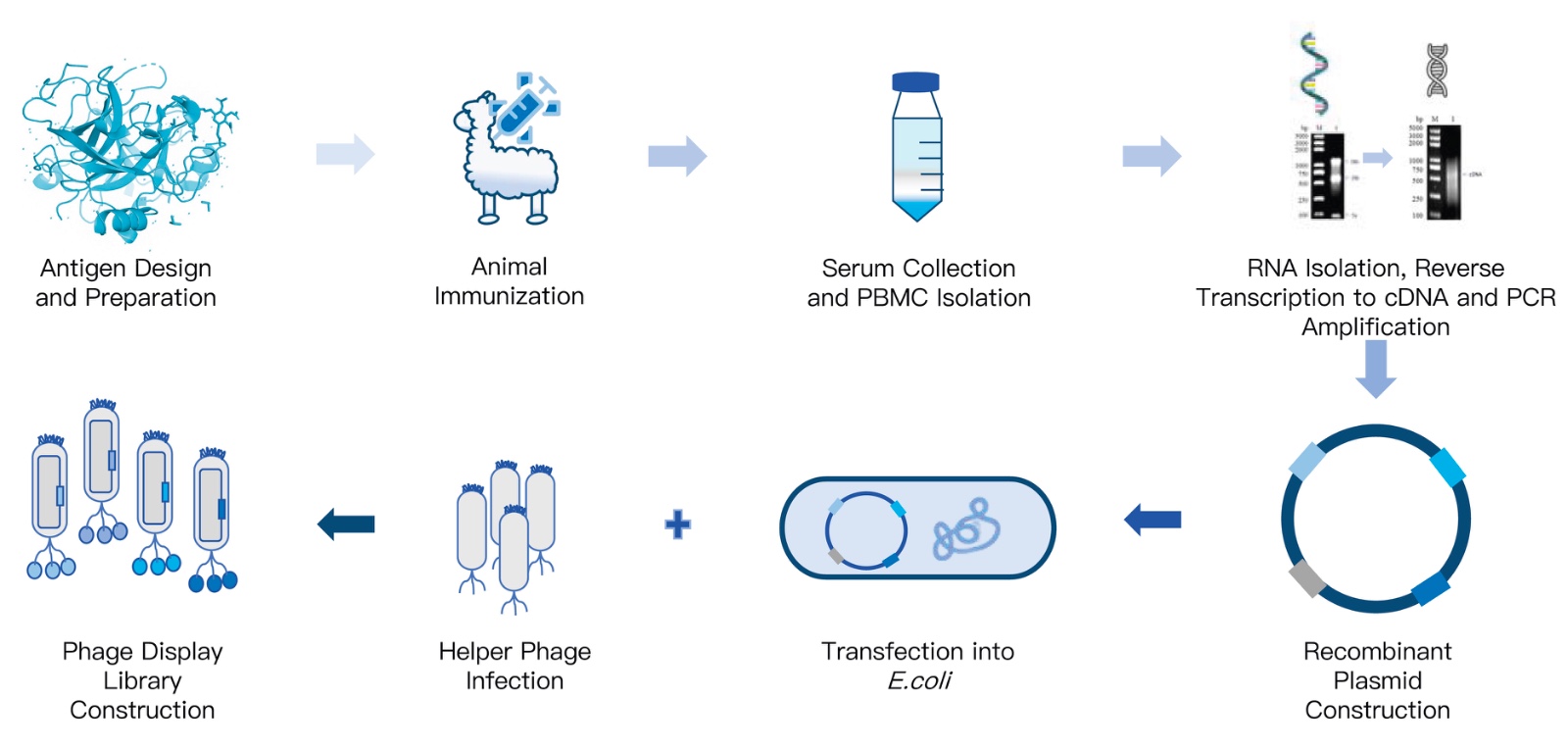
Among all high throughput screening methods, Phage Display remains one of the most powerful and versatile for therapeutic antibody discovery. This technique involves inserting a gene encoding a protein of interest into a phage coat protein gene, causing the phage to display the protein on its outside while containing the gene for the protein on its inside. This creates a direct link between genotype and phenotype.
From our experience, the scalability of this method is unparalleled. A single library can contain upwards of ten billion distinct variants. During the biopanning process, this massive library is exposed to an immobilized target antigen. Non-binding phages are washed away, while specific binders are eluted and amplified. At KMD Bioscience, our proprietary Phage Display Platform is heavily optimized for constructing and screening diverse libraries. We recommend utilizing this specific screening method when attempting to discover novel monoclonal antibodies or highly specific peptide binders, as it allows for the rapid isolation of high-affinity candidates within weeks.
2.2 Fluorescence Resonance Energy Transfer (FRET)
Fluorescence Resonance Energy Transfer (FRET) is a distance-dependent physical process by which energy is transferred non-radiatively from an excited molecular fluorophore (the donor) to another fluorophore (the acceptor). When applied as one of the primary high throughput screening methods, FRET provides a highly sensitive readout for protein-protein interactions, receptor activation, and protease cleavage assays.
The beauty of FRET lies in its homogeneous nature; it often requires no washing steps, making it exceptionally well-suited for miniaturization into 384-well or 1536-well microplate formats. We recommend Time-Resolved FRET (TR-FRET) for screens prone to high background auto-fluorescence. By introducing a time delay before measurement, short-lived background fluorescence decays, leaving only the specific signal from the target interaction. This ensures data integrity when screening massive compound libraries.
2.3 High-Content Screening (HCS)
While traditional high throughput screening methods often rely on a single readout (e.g., total fluorescence), High-Content Screening (HCS) combines automated microscopy with sophisticated image analysis algorithms to extract multiparametric data from whole cells. HCS allows researchers to observe complex cellular phenotypes, such as target localization, morphological changes, apoptosis, and cell cycle progression simultaneously.
From our experience, phenotypic screening via HCS is invaluable when the exact molecular target is unknown or when assessing the off-target toxicity of an antibody candidate. Because it provides a wealth of data regarding the biological context of the compound's activity, HCS acts as a critical bridge between primary binding assays and in vivo preclinical models. It requires significant computational power to process terabytes of image data, but the depth of biological insight gained makes it an indispensable tool.
2.4 Surface Plasmon Resonance (SPR)
Surface Plasmon Resonance (SPR) is an optical technique utilized for measuring molecular interactions in real-time without the need for fluorescent or radioactive labels. As one of the most critical high throughput screening methods for antibody characterization, SPR provides detailed kinetic data, including association rates (Kon), dissociation rates (Koff), and overall binding affinity (KD).
In modern high-throughput setups, SPR instruments can evaluate hundreds of interactions simultaneously. We recommend deploying SPR during the lead optimization phase. Once our Antibody Expression & Validation Platform generates recombinant antibody candidates, SPR is utilized to rank these variants based on their binding kinetics. Understanding how quickly an antibody binds to its target and how long it remains bound is paramount for predicting its therapeutic efficacy and dosing regimen in a clinical setting.
2.5 Automated Enzyme-Linked Immunosorbent Assay (ELISA)
The Enzyme-Linked Immunosorbent Assay (ELISA) is a foundational biochemical technique that has been highly adapted for automation. Modern high throughput screening methods frequently employ robotic liquid handling systems to perform thousands of ELISA tests daily. This assay relies on specific antigen-antibody interactions and an enzymatic reaction to produce a quantifiable colorimetric, fluorometric, or chemiluminescent signal.
Automated ELISA is robust, cost-effective, and highly scalable. From our experience, it serves as an excellent primary screening tool for evaluating serum titers, hybridoma supernatants, and preliminary binding specificities. While it may not provide the real-time kinetic data of SPR, its high capacity and reliability make it a cornerstone of the Recombinant Antibody and Protein Expression and Purification Platform workflow at KMD Bioscience.
3. Integrating Screening with Advanced Antibody Discovery Platforms
The true power of high throughput screening methods is unlocked when they are seamlessly integrated into specialized discovery pipelines. As an established CRO with over 30 patents and 4 registered trademarks, KMD Bioscience ensures that screening is not an isolated event, but a coordinated phase within a broader development strategy.
For example, when clients utilize our VHH Antibody Platform to discover single-domain antibodies (nanobodies), we frequently deploy a combination of Phage Display Technology and high-throughput automated ELISA. Because VHH antibodies are small and highly stable, they are exceptionally amenable to phage display panning against complex membrane proteins. Following the identification of lead candidates via these high throughput screening methods, the molecules transition into our Antibody Humanization Platform. Here, structural modeling and CDR-grafting are employed to reduce immunogenicity while retaining the precise binding affinities confirmed during the initial high-throughput SPR screening.
Each year, our company offers nearly a thousand technical service consultations and solution designs globally. We rely on the rigorous data generated by these high throughput screening methods to move projects confidently into our Stable Cell Line Development and Microbial Strain Engineering Platform, guaranteeing that the final therapeutic candidates are both highly specific and manufacturing-ready.
4. Summary Table: High Throughput Screening Methods
To assist researchers in selecting the optimal technology for their specific developmental phase, we have summarized the five core high throughput screening methods below.
| Screening Method | Primary Application | Key Advantage | KMD Bioscience Recommended Use Case |
|---|---|---|---|
| Phage Display Technology | Antibody and peptide discovery | Massive library capacity (10^10 variants) | De novo discovery of monoclonal and VHH antibodies. |
| FRET / TR-FRET | Protein-protein interaction assays | Homogeneous, no-wash format | High-volume small molecule and receptor screening. |
| High-Content Screening (HCS) | Phenotypic and cellular profiling | Multiparametric data from whole cells | Assessing complex cellular responses and off-target toxicity. |
| Surface Plasmon Resonance (SPR) | Binding kinetics and affinity | Real-time, label-free data | Lead optimization and exact kinetic ranking of variants. |
| Automated ELISA | Binding specificity and quantification | Highly scalable, cost-effective | Primary screening of hybridoma supernatants and expression yields. |
5. Frequently Asked Questions (FAQs)
How do high throughput screening methods reduce the timeline of drug discovery?
High throughput screening methods utilize advanced robotics, sensitive detectors, and specialized software to test thousands of candidates simultaneously. From our experience, automating these assays reduces the primary discovery phase from years to a matter of weeks, allowing researchers to quickly discard non-binders and focus exclusively on high-potential leads.
Why is Phage Display considered superior to traditional hybridoma technology in some cases?
While hybridoma technology requires animal immunization and is limited by the host's immune tolerance, Phage Display is an in vitro method. It allows for the screening of massive synthetic libraries against toxic or highly conserved antigens that would fail to provoke an immune response in animals. We recommend our Phage Display Platform for challenging targets.
What is the difference between primary and secondary high throughput screening methods?
Primary screening (like Automated ELISA or FRET) is designed for raw speed and capacity, testing millions of compounds to find initial "hits." Secondary screening (like SPR or HCS) is more complex and lower-throughput, designed to validate those hits by assessing precise binding kinetics or detailed cellular phenotypes.
How does KMD Bioscience ensure the accuracy of its screening data?
As an organization holding ISO9001:2015 Quality Management System certification, we implement stringent quality control protocols at every stage. Furthermore, over 90% of our technical service team members hold a master degree or higher, ensuring that the design, execution, and data interpretation of all high throughput screening methods meet rigorous scientific standards.
6. References
For scientists and engineers seeking to further their understanding of high throughput screening methods, assay miniaturization, and antibody engineering, we recommend consulting the following authoritative industry resources:

- Protein Platform
- Protein Expression Services
- Protein Modification & Detection Services
- Protein Interaction Services
- Protein Purification Service
- Antibody Discovery Platform
- VHH Antibody Platform
- Phage Display Platform
- Antibody Humanization Platform
- Single B Cell Screening Platform
- Antibody Expression & Validation Platform
- Peptide Library Platform
- Custom Antibody Platform
- Innovative Drug Discovery Platform
- Product Center
- Proteins
- Antibodies
- Raw Materials Reagents
- Small Molecule Reagents
- Peptide Products
- Nanoparticle Products
- Contact Us
- Phone:400-621-6806
- Mobile:13110936064(WeC
- E-mail:[email protected]
- Address:Room 108, Building 10, No. 6 Hechang Road, Wuqing Development Zone, Tianjin City
-

WeChat
-

Service Account
-
 400-621-6806
 -
 3599163699
 -
 Monday to Friday 9:00-18:00
 -

-
 0
0
-
