


The immunogen type of nanobodies
- 2026-05-14
- 492
1.Introduction to Nanobodies
Nanobodies (Nb) consist solely of two heavy chains, with the variable region of the heavy chain referred to as VHH (variable domain of the heavy chain of heavy-chain antibody). The recombinantly expressed VHH has a molecular weight of only 15 kDa, approximately one-tenth that of a conventional antibody and half that of antigen-binding fragments (e.g., scFv or VH-VL). Due to the absence of a light chain, nanobodies possess only three complementarity-determining regions (CDRs) derived from the heavy chain. To compensate for the missing light chain CDRs, nanobodies feature an elongated CDR3 (16–18 amino acid residues, compared to 8–15 in conventional antibodies), enhancing diversity and specificity in antigen recognition.
Immunogenicity is influenced by molecular weight and chemical structure—smaller molecules generally exhibit lower immunogenicity. Given that nanobodies are one-tenth the size of conventional antibodies and consist of a single domain, they are less likely to induce specific antibody formation or trigger humoral/cellular immune responses. Additionally, the absence of an Fc region avoids complement activation mediated by Fc, resulting in minimal immunogenicity in humans and excellent biocompatibility. However, some studies suggest that prolonged and repeated therapeutic use of nanobodies may increase immunogenicity, potentially affecting treatment efficacy. Nevertheless, compared to traditional antibodies, nanobodies demonstrate significantly lower immunogenicity.
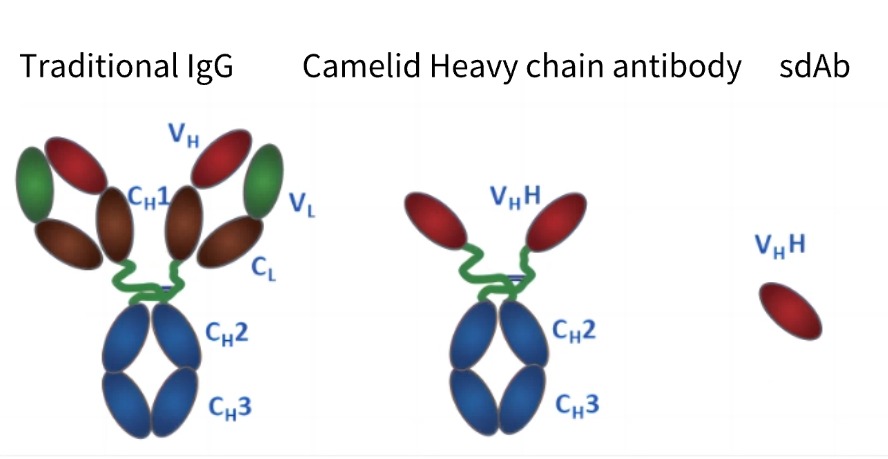
Figure 1: Structural comparison between conventional IgG antibodies and camelid nanobodies
2.Types of Immunogens
2.1 Protein Immunogen
(1) Characteristics: Protein immunogens are typically composed of whole proteins or recombinant protein fragments, which can effectively mimic antigenic epitopes under natural conditions, stimulate robust immune responses, and thereby induce the production of nanobodies with high affinity and specificity.
(2) Preparation: The production process includes gene cloning, protein expression (in bacteria, yeast, insect cells, or mammalian cells), purification (using various chromatographic techniques), and ensuring antigenicity (e.g., proper folding and post-translational modifications).
(3) Applications: Due to their complex tertiary structures, protein immunogens are commonly used to elicit strong immune responses and play a crucial role in the identification and development of nanobodies.
2.2 Small Molecule Immunogen
(1) Characteristics: Small molecules typically refer to compounds with a molecular weight below 1 kDa. Due to their low molecular weight, they are inherently insufficient to trigger an immune response and therefore need to be conjugated with larger carrier proteins to enhance their immunogenicity.
(2) Preparation: The preparation of small molecule immunogens involves selecting appropriate carrier proteins, followed by chemically conjugating the small molecules to these carrier proteins to form immunogens capable of inducing an immune response.
(3) Applications: Due to their complex tertiary structures, protein immunogens are commonly used to elicit strong immune responses and play a crucial role in the identification and development of nanobodies.
2.3 Peptide Immunogen
(1) Characteristics: Peptide immunogens consist of short amino acid chains that can be either linear or conformationally constrained. They are typically used to mimic localized epitopes of protein antigens and often require appropriate design and modification to enhance their stability and immunogenicity.
(2) Preparation: The preparation strategy generally involves solid-phase peptide synthesis and purification, along with potential conformational constraint approaches (e.g., cyclization). For longer peptides, genetic engineering methods may also be employed for expression and purification.
(3) Applications: Due to their relatively straightforward preparation process and cost-effectiveness, peptide immunogens find wide applications in various fields including vaccine design, disease research, and diagnostic tool development.
2.4 Viral Immunogen
(1) Characteristics: Viral immunogens are specific proteins or viral particles extracted from viruses that can induce host immune responses. These immunogens are typically inactivated, rendering them incapable of causing disease while still being sufficient to trigger the host's immune system to develop viral defenses.
(2) Preparation: The production process involves virus collection and inactivation, immunogen extraction and purification, immunogen characterization, immunization procedures, nanobody screening and production, quality control, and final product packaging and delivery.
(3) Applications: With the global urgent demand for new vaccines and therapeutic solutions, the market need for viral immunogens is growing rapidly. Furthermore, as technology advances and new viruses emerge, the demand for high-quality immunogens continues to increase.
2.5 DNA Immunogen
(1) Characteristics:This type of immunogen is typically prepared by synthesizing the DNA sequence encoding the target protein. The advantage of DNA immunogens lies in their precise control over the protein-coding sequence, enabling the generation of specific antibodies. Additionally, DNA immunogens are relatively simple to prepare and cost-effective.
(2) Preparation:The preparation strategy generally includes cloning and vector selection, delivery efficiency, antigen expression and processing, and induction of immune responses.
(3) Applications:DNA immunization technology has been successfully used to develop a wide range of monoclonal antibodies and nanobodies derived from different species. It has found broad applications in scientific research, clinical diagnostics, and disease treatment.
2.6 RNA Immunogen
(1) Characteristics: RNA immunogens are highly useful for studying specific RNA isoforms and post-transcriptional modifications. However, they are difficult to stabilize and involve complex procedures.
(2) Preparation: Similar to DNA immunogens, RNA immunogens are prepared by synthesizing RNA sequences encoding the target protein. The key challenge lies in obtaining highly immunogenic antigens to ensure successful antibody production. In this process, the technical critical points of synthesis and modification are crucial.
(3) Applications: Direct in vivo injection of prophylactic vaccines against infectious diseases, therapeutic mRNA vaccines for cancer, and mRNA-encoded immunotherapy.
2.7 Cell Line-Derived Immunogen
(1) Characteristics: This is a method that uses cell lines as immunogens, typically generating antibodies through cell lines expressing the target protein.
(2) Preparation: Using cell lines as immunogens involves more steps, including cultivation and cell extraction. Cell Culture: Maintaining and culturing cell lines requires special attention to ensure cell health and high expression of the immunogen. Extraction Method: Extracting the immunogen from cells requires appropriate techniques to preserve the protein's native structure and activity.Different cell lines have distinct properties, making the selection of a suitable cell line crucial.
(3) Applications: Cell line-based immunogens are suitable for studying protein function and localization within cells. However, they are more complex in terms of establishing and maintaining stable cell lines.
KMD Bioscience is committed to providing high-quality nanobody preparation services for our clients. With a professional team and advanced technology platform, we offer customized design of nanobodies with high affinity and specificity tailored to customer needs. Our services cover the entire process, from selecting antigen-immunized animals and antigen preparation to nanobody screening and production. Whether it's custom nanobody preparation for specific antigens or functional modifications for particular applications, we deliver personalized solutions. Through our expertise and stringent quality control system, we ensure high-quality and efficient nanobody preparation services. Our nanobodies provide robust support for both research and clinical applications, empowering customers in their scientific studies and product development.
- nanobody production
- nanobody expression
- VHH nanobody
- nanobody immunogen selection

- Protein Platform
- Protein Expression Services
- Protein Modification & Detection Services
- Protein Interaction Services
- Protein Purification Service
- Antibody Discovery Platform
- VHH Antibody Platform
- Phage Display Platform
- Antibody Humanization Platform
- Single B Cell Screening Platform
- Antibody Expression & Validation Platform
- Peptide Library Platform
- Custom Antibody Platform
- Innovative Drug Discovery Platform
- Product Center
- Proteins
- Antibodies
- Raw Materials Reagents
- Small Molecule Reagents
- Peptide Products
- Nanoparticle Products
- Contact Us
- Phone:400-621-6806
- Mobile:13110936064(WeC
- E-mail:[email protected]
- Address:Room 108, Building 10, No. 6 Hechang Road, Wuqing Development Zone, Tianjin City
-

WeChat
-

Service Account
-
 400-621-6806
 -
 3599163699
 -
 Monday to Friday 9:00-18:00
 -

-
 0
0
-
