


Monkeypox Virus
- 2026-07-10
- 267
Monkeypox virus (MPV, MPXV, or hMPXV), also known as mpox virus, is a double-stranded DNA virus that causes pox in humans and other mammals. Monkeypox virus is a zoonotic virus belonging to the genus Orthopoxvirus, making it closely related to variola (VARV), cowpox (CPX), and vaccinia (VACV) viruses. MPV is oval in shape and has a lipoprotein envelope. Its genome is approximately 190 kb.
Both smallpox and monkeypox viruses are orthopoxviruses; if the smallpox vaccine was administered within 3–5 years prior to infection, it provides protection against monkeypox. The clinical presentation of monkeypox is similar to that of smallpox, but the rash is milder and the case fatality rate is lower. The virus spreads between animals and humans through direct contact with lesions or bodily fluids. The virus was named monkeypox virus after being isolated from monkeys, but rodents are the primary carriers of this virus.
Virus isolates from Central Africa are more virulent than those from West Africa. The two regions have distinct viral lineages; the former Congo Basin (Central Africa) lineage is referred to as Lineage I, while the former West African lineage is referred to as Lineage II. Although monkeypox virus has many natural hosts, the exact host and the mode of transmission in nature require further study.
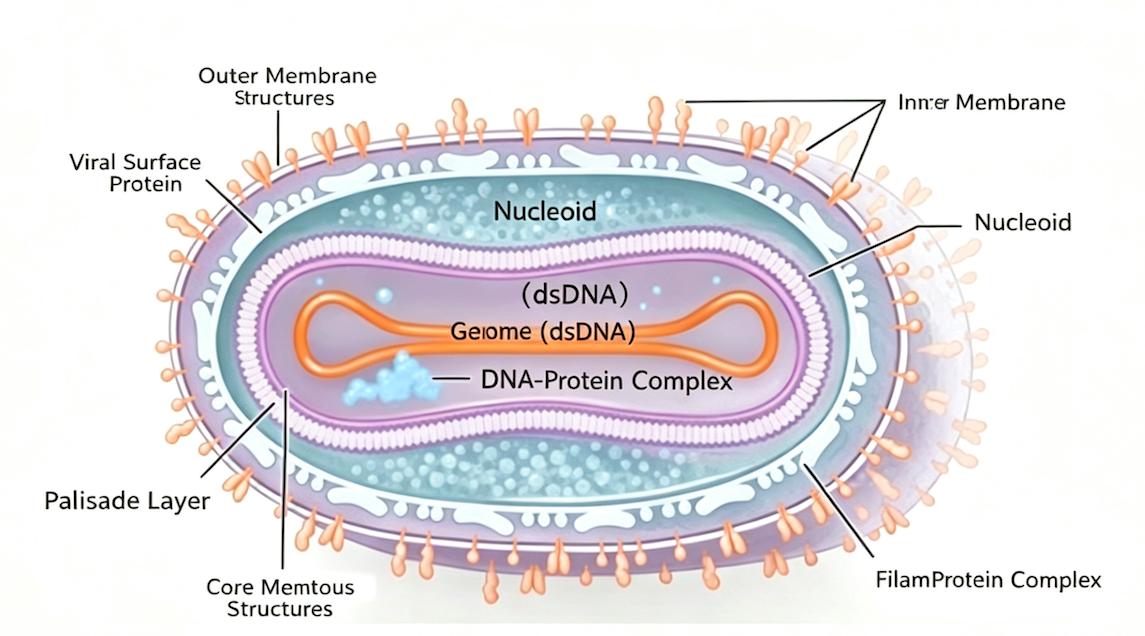
Like other poxviruses, the monkeypox virus is oval in shape and has a lipoprotein envelope. The envelope protects the virus’s enzymes, DNA, and transcription factors. Typical DNA viruses replicate and express their genomes within the nuclei of eukaryotic cells, and they are heavily dependent on host cells; however, the monkeypox virus relies primarily on proteins encoded by its genome, which enable it to replicate in the cytoplasm.
The monkeypox virus genome is approximately 200 kb long and encodes about 200 proteins. It consists of double-stranded DNA arranged in a linear configuration, with hairpin-shaped ends covalently sealed; the central region of the genome encodes genes involved in key functions, such as viral transcription and assembly; genes located at both ends of the viral genome are more closely associated with interactions between the virus and the host cell, such as spike protein characteristics.
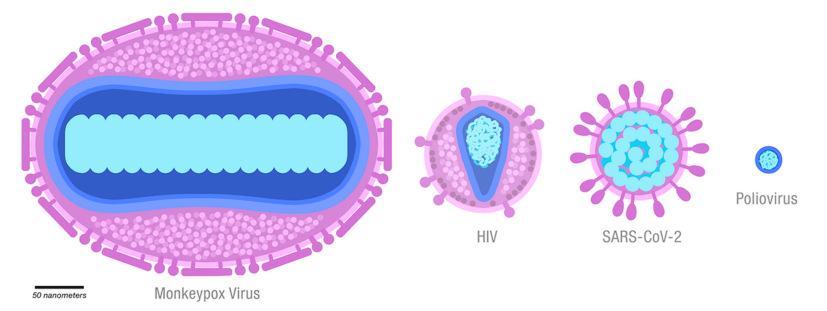
Compared to other viruses, the monkeypox virus is relatively large. This makes it more difficult for the virus to breach the host’s defense systems, such as crossing gap junctions. Furthermore, its large size makes it harder for the virus to replicate rapidly and evade the immune response. To evade the host’s immune system and gain more time for replication, monkeypox and other orthopoxviruses have evolved the ability to evade host immune cells by encoding intracellular and extracellular regulatory proteins.
The figure below compares the size and structure of the monkeypox virus with those of HIV, SARS-CoV-2, and poliovirus. (Membranes and membrane-associated proteins are shown in purple, capsids in dark blue, and genome and nucleolus-associated proteins in turquoise.)
The monkeypox virus has multiple surface proteins that facilitate its entry into host cells; the virus can fuse with host cells using 11 to 12 transmembrane proteins. It may bind to glycosaminoglycans or laminin on the cell surface. Because it is a DNA virus, it is less likely to mutate than RNA viruses such as SARS-CoV-2. Currently, the key proteins being studied in monkeypox virus strains include A29, A35, B6R, A33R, M1R, L1R, I1L, and A5L.
- Monkeypox virus
- MPV
- MPXV
- hMPXV

- Protein Platform
- Protein Expression Services
- Protein Modification & Detection Services
- Protein Interaction Services
- Protein Purification Service
- Antibody Discovery Platform
- VHH Antibody Platform
- Phage Display Platform
- Antibody Humanization Platform
- Single B Cell Screening Platform
- Antibody Expression & Validation Platform
- Peptide Library Platform
- Custom Antibody Platform
- Innovative Drug Discovery Platform
- Product Center
- Proteins
- Antibodies
- Raw Materials Reagents
- Small Molecule Reagents
- Peptide Products
- Nanoparticle Products
- Contact Us
- Phone:400-621-6806
- Mobile:13110936064(WeC
- E-mail:[email protected]
- Address:Room 108, Building 10, No. 6 Hechang Road, Wuqing Development Zone, Tianjin City
-

WeChat
-

Service Account
-
 400-621-6806
 -
 3599163699
 -
 Monday to Friday 9:00-18:00
 -

-
 0
0
-
