


Introduction to the application prospects of Antibody Affinity Maturation
- 2026-05-14
- 275
I. Background
Antibodies serve as the body’s primary weapon for precise recognition and elimination of specific pathogens, with affinity being a critical determinant of their biological efficacy. When deployed for diagnostics, therapeutics, or basic research, antibodies often require significantly higher affinity than their natural state. This need is addressed through antibody affinity maturation technology, which transforms low-affinity antibodies into ultra-high-affinity, highly specific variants under laboratory conditions. This process further optimizes antibodies for suitable pharmacokinetic properties, substantially expanding their utility. It also mitigates the side effects of existing antibody-based drugs and accelerates advancements in fields such as: antibody-drug conjugates (ADCs), chimeric antigen receptors (CARs) in CAR-T therapy and novel nanobody platforms.
II. VHH Nanobodies
VHH antibodies are unique single-domain antibodies naturally found in camelids (camels, llamas) and sharks. Unlike conventional antibodies, VHH lacks a light chain and the CH1 domain, comprising only a single VHH fragment in its variable region. With a molecular weight merely 10% of traditional antibodies, VHH exhibits superior tissue penetration capabilities, enabling deep infiltration into tumors and traversal across the blood-brain barrier. By overcoming the limitations of conventional antibodies—such as large size and low stability—VHH antibodies demonstrate significant potential for diagnostic and therapeutic applications.
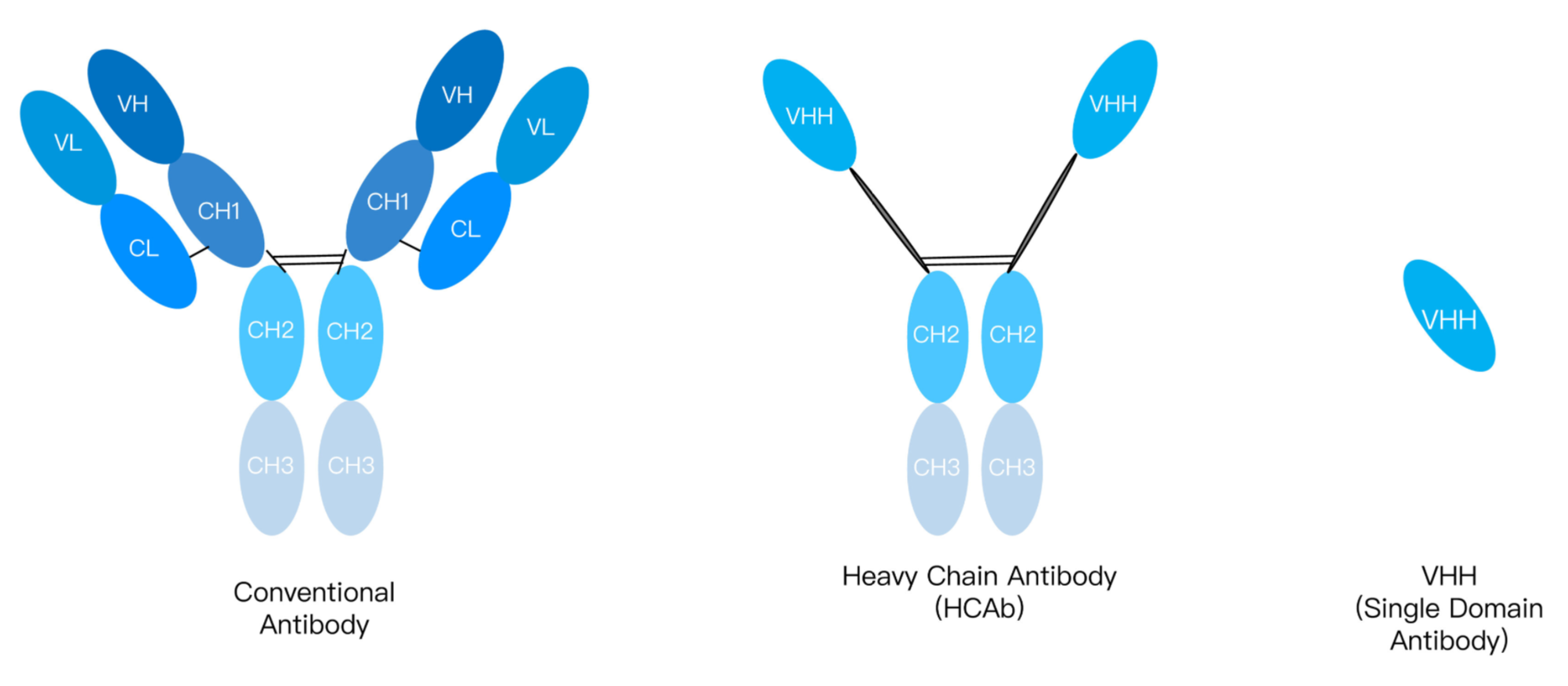
Structure diagram of VHH antibody
III. Antibody Affinity Maturation
Affinity maturation is an important step in enhancing the binding ability of antibodies to their targets. By making targeted modifications to the complementarity-determining regions (CDRs) of antibodies, the binding strength and specificity between antibodies and targets can be improved. This process involves building an immune source, parsing the database to obtain the initial sequence, conducting initial screening of positive clones, obtaining germline genes, and using mismatch PCR to retain the natural diversity of the basic library. Through the use of a tri-nucleotide mutation method to introduce a tunable and more precise regulatory mutation strategy, a phage/yeast display library with a scale of 10⁸ - 10¹¹ can be constructed. The mutation introduction strategy includes rational design and directed evolution methods. Finally, high-affinity sequences are obtained through high-throughput screening. Currently, this modern technology platform has achieved the first closed-loop system, namely AI pre-screening and automatic sorting, which has successfully shortened the original 6-month cycle to 4 weeks.
IV. VHH Antibody Affinity Maturation
During the in vivo immune response process, in order to enhance the ability of immunoglobulins to recognize and bind to foreign antigens, the H chain of antibodies undergoes V-D-J gene fragment recombination. Within germinal centers, B lymphocytes conduct in vivo affinity maturation via class switch recombination (CSR) alongside somatic hypermutation (SHM) occurring specifically in complementarity-determining regions (CDRs). Owing to their distinctive structural properties, VHH antibodies demonstrate heightened compatibility with in vitro affinity maturation approaches. Established strategies—including error-prone PCR, DNA recombination, and chain exchange—are now routinely implemented for this purpose.
Relative to conventional antibodies, VHH molecules display greater structural diversity within their CDRs. Notably, the CDR-H3 loop serves as a critical determinant during antigen recognition processes. Therefore, mutating or modifying the CDR regions of VHH antibodies is the most critical approach. By grafting specific CDRs onto the CDR of the VHH variable domain of camel species, the binding affinity of the antibody can be enhanced. We can also construct a synthetic phage library based on the synthetic nanobody library scaffold c Ab BCII10 and introduce random sequences into the CDR3 of VHH to obtain VHH antibodies with higher affinity.
V. Antibody Affinity Maturation Drug Development and Application
The antibody affinity maturation technology is profoundly changing the research and development landscape of therapeutic antibodies. Its main application scenarios include:
1) Targeted treatment of solid tumors: Producing high-affinity antibodies to overcome the dense matrix layer and low-expression heterogeneity of target sites. For example, the affinity-optimized anti-PD-L1 nanobody has a 5-fold increase in tumor penetration ability, resulting in a longer survival period for KN046 compared to the control group.
2) Design of bispecific antibodies: Achieving targeted synergy through differential affinity regulation. The bispecific design of CD3×tumor antigen will reduce the toxicity of T cell overactivation due to the decreased affinity for CD3, and increase the targeting efficiency due to the enhanced super-affinity for tumor antigens, which can increase the objective response rate of ovarian cancer from 28% of the single antibody to 54%.
3) Intracellular antibody development: Utilizing affinity maturation to break through the bottleneck of traditional antibody intracellular delivery. Optimizing the CDR3 region of the nanobody-based PROTAC degrader can increase the intracellular binding ability by 8 times. The degradation rate of mutant proteins induced by PDX lung cancer model reaches 92%, which can be used for intractable drug-resistant targets.
In response to the demand for high affinity of antibody-based drugs, KMD Bioscience integrates biotechnological means such as phage display, yeast display, directed evolution, and AI-assisted design to establish an ultra-large-scale mutation library. Using high-sensitivity screening methods such as FACS and SPR, it improves the antibody affinity by tens to thousands of times. It is particularly proficient in the field of nanobodies. KMD Bioscience has an experienced international talent team, flexible personalized solutions, and a dual optimization platform for traditional antibodies and nanobodies, accelerating your progress from candidate molecules to preclinical research. Welcome to consult!
[1] Chaudhuri D, Majumder S, Datta J, Giri K. Designing of nanobodies against Dengue virus Capsid: a computational affinity maturation approach. J Biomol Struct Dyn. 2023; 41(6): 2289-2299.
[2] Yu H, Mao G, Pei Z, et al. In Vitro Affinity Maturation of Nanobodies against Mpox Virus A29 Protein Based on Computer-Aided Design. Molecules. 2023; 28(19): 6838.
[3] Lowden MJ, van Faassen H, Raphael S, Ryan S, Hussack G, Henry KA. Facile Affinity Maturation of Single-Domain Antibodies Using Next-Generation DNA Sequencing. Methods Mol Biol. 2022; 2446: 245-268.

- Protein Platform
- Protein Expression Services
- Protein Modification & Detection Services
- Protein Interaction Services
- Protein Purification Service
- Antibody Discovery Platform
- VHH Antibody Platform
- Phage Display Platform
- Antibody Humanization Platform
- Single B Cell Screening Platform
- Antibody Expression & Validation Platform
- Peptide Library Platform
- Custom Antibody Platform
- Innovative Drug Discovery Platform
- Product Center
- Proteins
- Antibodies
- Raw Materials Reagents
- Small Molecule Reagents
- Peptide Products
- Nanoparticle Products
- Contact Us
- Phone:400-621-6806
- Mobile:13110936064(WeC
- E-mail:[email protected]
- Address:Room 108, Building 10, No. 6 Hechang Road, Wuqing Development Zone, Tianjin City
-

WeChat
-

Service Account
-
 400-621-6806
 -
 3599163699
 -
 Monday to Friday 9:00-18:00
 -

-
 0
0
-
