


Popular Science on Antibody Humanization
- 2026-07-10
- 723
Non-human antibodies can induce severe immune rejection in humans, thereby compromising the safety and therapeutic efficacy of antibodies in clinical applications. Therefore, humanization of antibodies is required to minimize their heterogeneity while maintaining their specificity and affinity.
Antibody humanization involves replacing the scaffold and secondary amino acids of the CDR region in non-human antibodies (e.g., murine monoclonal antibodies) with human antibody scaffolds through DNA recombination and protein engineering technologies, thereby reducing the various limitations of murine-derived antibodies in clinical applications. Antibody humanization is a crucial component of recombinant antibody production and preparation research, as well as a key direction in the development of antibody drugs.
I. Principles of Antibody Humanization
Each variable region of an antibody contains three amino acid sequences known as complementarity-determining regions (CDRs), which are antigen-binding sites that complement the antigenic determinants. The amino acid sequences and spatial structures of CDRs are critical factors in determining antibody heterogeneity and affinity. Humanized antibodies refer to those whose constant regions (i.e., the CH and CL regions) or entire structure are encoded by human antibody genes. Such antibodies can reduce the immune adverse reactions caused by heterologous antibodies in humans
The fundamental principle of antibody humanization is to retain the conserved sequence of the antibody as the human sequence, reduce the risk of immune rejection, and replace the antigen-binding region with the sequence of antibodies produced after animal immunization, thereby maintaining the specificity and affinity of the antibody. The basic principles to be followed during antibody humanization include: reducing or essentially eliminating the immunogenicity of theantibody.
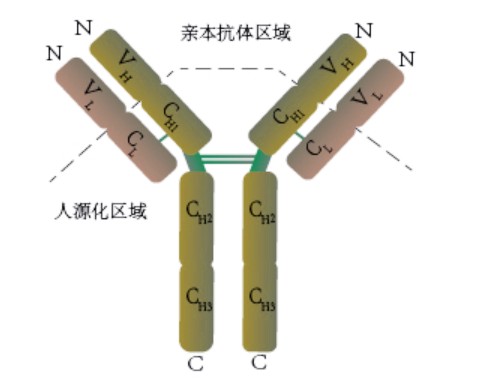
Figure 1 Antibody Structure
II. Classification of Humanized Antibodies
The humanization process of antibodies has undergone three stages: human-mouse chimeric antibodies, humanized antibodies, and fully humanized antibodies. Antibody humanization requires genetic engineering techniques. Based on the degree of antibody sequence modification, humanized antibodies can be classified into several categories, including chimeric antibodies, modified antibodies, and fully humanized antibodies.
Chimeric antibodies refer to the combination of the variable region of heterologous antibodies with the constant region of human antibodies, such as human-mouse chimeric antibodies. Such antibodies retain the affinity and specificity of the parent mouse monoclonal antibody while reducing the immunogenicity of murine antibodies inhumans.
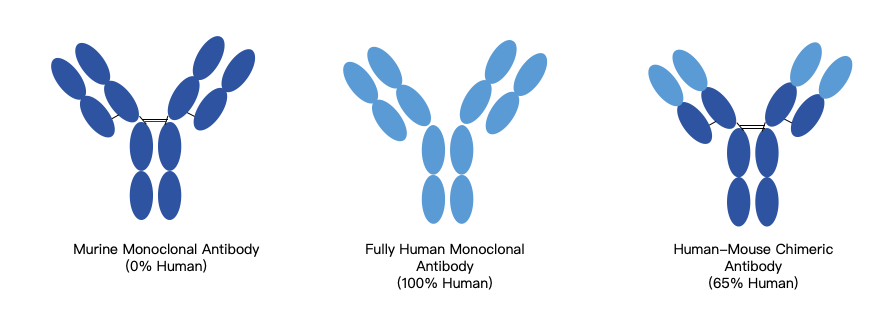
Figure 2 Chimeric Antibody
Modified antibodies, also known as CDR grafting antibodies, undergo preliminary humanization through CDR grafting. Building upon this foundation, individual amino acid residues in the framework region are further adjusted to enhance the specificity and affinity of the CDR grafting antibodies.
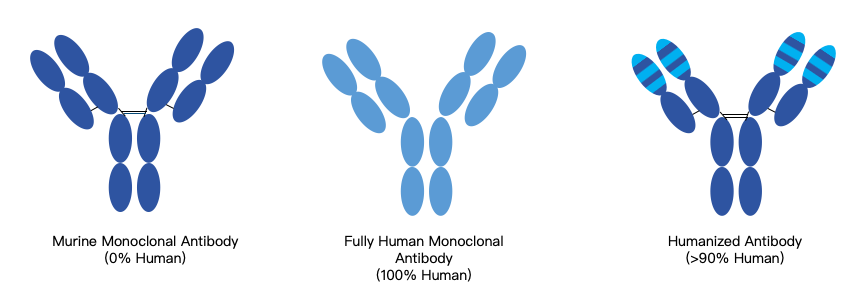
Figure 3 Modified Antibody
Fully human antibodies refer to antibodies whose entire sequence is derived from human sources. Through gene editing technology, the antibody gene in animal somatic cells is replaced with human antibody genes, enabling direct production of fully humanized antibodies after animal immunization. This is primarily achieved through antibody library technologies such as phage display.
III. Application of fully human antibodies in drug development
With the advancement of antibody technology, the number of novel antibody drugs entering clinical trials has shown a significant upward trend, with over 110 antibody drugs approved in 2015. In the fields of autoimmune diseases and oncology, monoclonal antibody drugs demonstrate clinical advantages over small-molecule drugs, including higher specificity and fewer adverse reactions. From the perspective of antibody drug development trends, humanized antibodies and fully human antibodies are the predominant types.
In recent years, the application of fully human antibodies has become increasingly widespread, particularly in the field of anti-tumor immunoglobulin drugs, where the variety of products has expanded significantly. The two primary technologies employed in fully human antibody development are phage antibody library technology and transgenic mouse technology. The first method is the "phage display" technique, which involves screening large-scale antibody libraries. The second method utilizes a mouse immunization platform, where mice are immunized with human antibody variable domain (VDJ) sequences, including the variable region (V), diverse region (D), and junction region (J) sequences. Approximately 70% of commercially available fully human antibodies are obtained through transgenic mouse technology.
After decades of research and development, the discovery technology of human antibodies and genetic engineering technology have reached maturity, with a variety of high-yield platforms available for use. Currently, several fully humanized monoclonal antibodies (mAbs) approved for clinical use can be applied to the treatment of various diseases, injecting new vitality into drug development. In the future, with continuous technological advancements, we will witness the emergence of more novel mAb-based drugs.
Camed Bio possesses extensive experience in antibody engineering. Leveraging our antibody phage display library platform, we provide high-affinity and low-immunogenicity chimeric antibody modification services. Camed Bio offers the following three categories of humanized antibody customization services:
Modified antibodies: The CDR region of non-human antibodies is transplanted into human antibodies lacking the CDR region, such as transplanting the CDR of murine antibodies into the framework of human antibodies, thereby endowing human antibodies with the antigen-binding specificity of murine monoclonal antibodies while reducing their heterogeneity.
Chimeric antibodies: Utilizing DNA recombination technology, the variable region genes of non-human antibody light and heavy chains are inserted into an expression vector containing the constant region of human antibody, followed by transfection of mammalian cells for recombinant antibody expression.
Fully humanized antibodies: Utilizing gene editing technology, the antibody gene in animal somatic cells is replaced with human antibody gene, enabling direct production of fully humanized antibodies after animal immunization.

- Protein Platform
- Protein Expression Services
- Protein Modification & Detection Services
- Protein Interaction Services
- Protein Purification Service
- Antibody Discovery Platform
- VHH Antibody Platform
- Phage Display Platform
- Antibody Humanization Platform
- Single B Cell Screening Platform
- Antibody Expression & Validation Platform
- Peptide Library Platform
- Custom Antibody Platform
- Innovative Drug Discovery Platform
- Product Center
- Proteins
- Antibodies
- Raw Materials Reagents
- Small Molecule Reagents
- Peptide Products
- Nanoparticle Products
- Contact Us
- Phone:400-621-6806
- Mobile:13110936064(WeC
- E-mail:[email protected]
- Address:Room 108, Building 10, No. 6 Hechang Road, Wuqing Development Zone, Tianjin City
-

WeChat
-

Service Account
-
 400-621-6806
 -
 3599163699
 -
 Monday to Friday 9:00-18:00
 -

-
 0
0
-
