


Biological functions of antibodies
- 2026-07-10
- 341
Antibodies play a crucial role in the immune system. They are immunoglobulins produced by plasma cells, which are differentiated from B lymphocytes or memory cells, and can specifically bind to corresponding antigens. The biological functions of antibodies are primarily reflected in the functional distinction between their Fab and Fc regions.
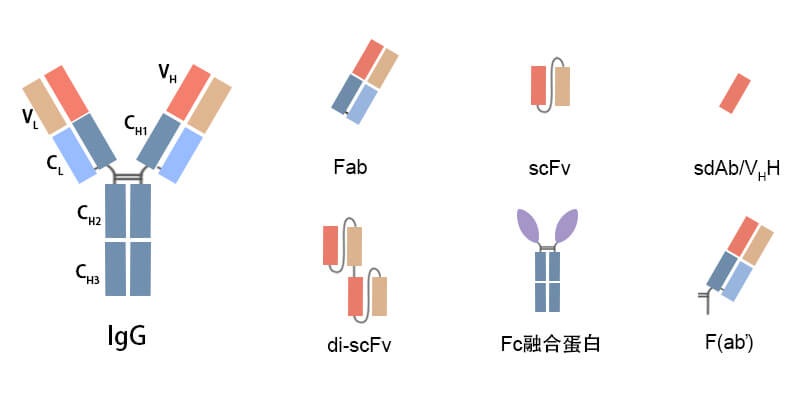
Functions mediated by the Fab fragment: Antigen recognition and pathogen neutralization.
Functions mediated by the Fc fragment: Activation of effector cells, initiation of the complement cascade, and opsonization (via Fc receptors on effector cell surfaces).
Complete antibodies exert complex physiological effects in the body, including the following aspects:
--Specific Binding to Corresponding Antigens
The antigen-binding site of an antibody is located in the hypervariable region of the antibody's variable (V) domain, which contains three complementarity-determining regions (CDRs). These CDRs directly determine the antibody's ability to bind only to its matching antigen with high affinity. When antibody affinity is insufficient, techniques such as genetic mutation or phage display library screening can be employed to mutate specific amino acid residues within the CDRs (antibody affinity maturation), significantly enhancing the antibody's affinity for the antigen.
The binding between antibodies and antigens relies on non-covalent interactions. Under appropriate conditions, such as optimal ionic concentration and pH, their binding is reversible. In humans, antibodies primarily exist in the IgG form, which forms bivalent complexes upon antigen binding. IgM serves as an early infection marker, with a theoretical valency of ten; however, due to steric hindrance, its effective valency is five. Dimeric IgA has a binding valency of four.
--Activation of the Complement Cascade Pathway
The Fc region of antibodies contains complement-binding sites: the binding site for IgM is located in the CH3 domain, while that for IgG is in the CH2 domain. To initiate the complement activation pathway, at least two closely spaced IgG molecules must bind to their corresponding antigens.
--Binding to Fc Receptors
After an antibody binds to an antigen, its free Fc region can interact with various Fc receptors (FcRs) on cell surfaces, triggering different effector functions: opsonization-enhanced phagocytosis, mediation of allergic reactions, and antibody-dependent cell-mediated cytotoxicity (ADCC).
(1) Opsonization-Enhanced Phagocytosis
When IgG molecules bind to particulate antigens such as bacteria, their Fc regions can interact with corresponding receptors (FcγR) on the surface of mononuclear phagocytes and neutrophils, thereby enhancing phagocytic activity—a process known as opsonization. When both complement and antibodies synergistically facilitate phagocytosis, it is termed combined opsonization.Neutrophils, monocytes, and macrophages express high- or low-affinity FcγRⅠ (CD64) and FcγRⅡ (CD32). Among IgG subclasses, human IgG1 and IgG3 play a major role in opsonization. Eosinophils express FcγRⅡ, and IgE, upon binding to its specific antigen, can enhance phagocytic activity in eosinophils.
(2) Mediation of Allergic Reactions
The Fc region of IgE binds to its corresponding receptor (FcεR) on the surface of mast cells and basophils, sensitizing these cells. Upon exposure to allergens, these cells degranulate and release bioactive substances such as histamine and bradykinin, leading to localized capillary dilation, increased vascular permeability, and triggering Type I hypersensitivity reactions.
(3) Antibody-Dependent Cellular Cytotoxicity (ADCC)
When IgG binds to target cells (e.g., virus-infected cells or tumor cells), its Fc region engages with FcγR on NK cells, inducing ADCC. Mononuclear phagocytes and neutrophils, which also express IgG Fc receptors, can similarly mediate ADCC against IgG-coated target cells.
--Placental Transfer
IgG is the only antibody capable of being transferred from mother to fetus, providing the fetus with innate passive immunity. Research indicates that maternal IgG is likely transported to the fetus by binding to specific receptors (FcγR) on the surface of placental trophoblast cells.
--Immunoregulation
Antibodies in the body exhibit both positive and negative immunoregulatory effects. When encountering pathogens, appropriate antibody production helps the body rapidly eliminate the infectious agents. However, under persistent antigen stimulation, the body tends to develop immune tolerance. In certain conditions, such as systemic lupus erythematosus, the body continuously produces high levels of antibodies, leading to autoimmune disorders.
KMD Bioscience is a leading biotechnology company specializing in high-quality antibody production services and products. Our services include, but are not limited to, custom development, expression, purification, as well as various downstream processing and functional validation of monoclonal and polyclonal antibodies. Leveraging advanced technological platforms and extensive industry expertise, we are committed to meeting the high-standard demands of clients in research, diagnostics, and biopharmaceutical fields for diverse antibody products.Our comprehensive antibody product portfolio covers a wide range of research areas, including but not limited to cancer, immunology, infectious diseases, neuroscience, and cell biology. Each antibody undergoes stringent quality control processes to ensure high affinity, specificity, and superior bioactivity. In addition to standard products, KMD Bioscience offers fully customized solutions, including antibody humanization, tag modification, affinity maturation, and more, to support customers' research projects and drug development initiatives.
- Antibody preparation
- antibody production
- antibody expression
- antibody products

- Protein Platform
- Protein Expression Services
- Protein Modification & Detection Services
- Protein Interaction Services
- Protein Purification Service
- Antibody Discovery Platform
- VHH Antibody Platform
- Phage Display Platform
- Antibody Humanization Platform
- Single B Cell Screening Platform
- Antibody Expression & Validation Platform
- Peptide Library Platform
- Custom Antibody Platform
- Innovative Drug Discovery Platform
- Product Center
- Proteins
- Antibodies
- Raw Materials Reagents
- Small Molecule Reagents
- Peptide Products
- Nanoparticle Products
- Contact Us
- Phone:400-621-6806
- Mobile:13110936064(WeC
- E-mail:[email protected]
- Address:Room 108, Building 10, No. 6 Hechang Road, Wuqing Development Zone, Tianjin City
-

WeChat
-

Service Account
-
 400-621-6806
 -
 3599163699
 -
 Monday to Friday 9:00-18:00
 -

-
 0
0
-
