


Introduction to SPR (Surface Plasmon Resonance) Technology
- 2026-07-10
- 280
1. What is SPR?
SPR (Surface Plasmon Resonance), also known as surface plasmon polariton resonance, is fundamentally a physical optical phenomenon.
2. The Development History of SPR Technology
In 1902, Wood discovered the SPR phenomenon in an optical experiment;
In 1941, Fano explained the SPR phenomenon;
In 1971, Kretschmann laid the foundation for the SPR sensor structure;
In 1983, Liedberg applied SPR to the detection of IgG and its antigen reaction;
In 1987, Knoll et al. began research on SPR imaging;
In 1990, Biacore AB developed the first commercial SPR instrument;
In 2016, SPR technology was officially included in the U.S. and Japanese Pharmacopoeias.
3. Applications of SPR Technology
SPR technology can be used for analyzing the binding specificity between biomolecules, concentration quantification, binding kinetics and affinity analysis, as well as thermodynamic studies. It enables real-time detection of interactions between various biomolecules, such as DNA and proteins, protein molecules, drugs and proteins, nucleic acids and nucleic acids, antigens and antibodies, as well as receptors and ligands.
4. SPR技术检测原理
First, let’s review a few physics concepts.
Plasma
Plasma typically refers to a gas composed of a high density of free positive and negative charges, where the number of positively and negatively charged particles is nearly equal, resulting in overall electrical neutrality. It is a state of matter, alongside solid, liquid, and gaseous states, and is considered the fourth state of matter. Most of the matter in the universe exists in the plasma state.
Surface Plasmon Wave (on Metal Surfaces)
The valence electrons in a metal can be regarded as an electron gas moving against a background of uniform positive charges, which essentially constitutes a type of plasma. Because valence electrons in metals can move freely, incident light can excite longitudinal oscillations in this electron gas. The resulting charge density wave propagates along the interface between the metal and a dielectric medium, forming a surface plasmon wave.
Evanescent Wave
When studying total internal reflection from the perspective of wave optics, it was discovered that when incident light reaches the interface, it does not directly generate reflected light. Instead, it first penetrates the optically less dense medium to a depth of about one wavelength, flows along the interface for approximately half a wavelength, and then returns to the optically denser medium—all without any change in the total energy of the light. The wave that penetrates the optically less dense medium is called the evanescent wave (see the figure below).
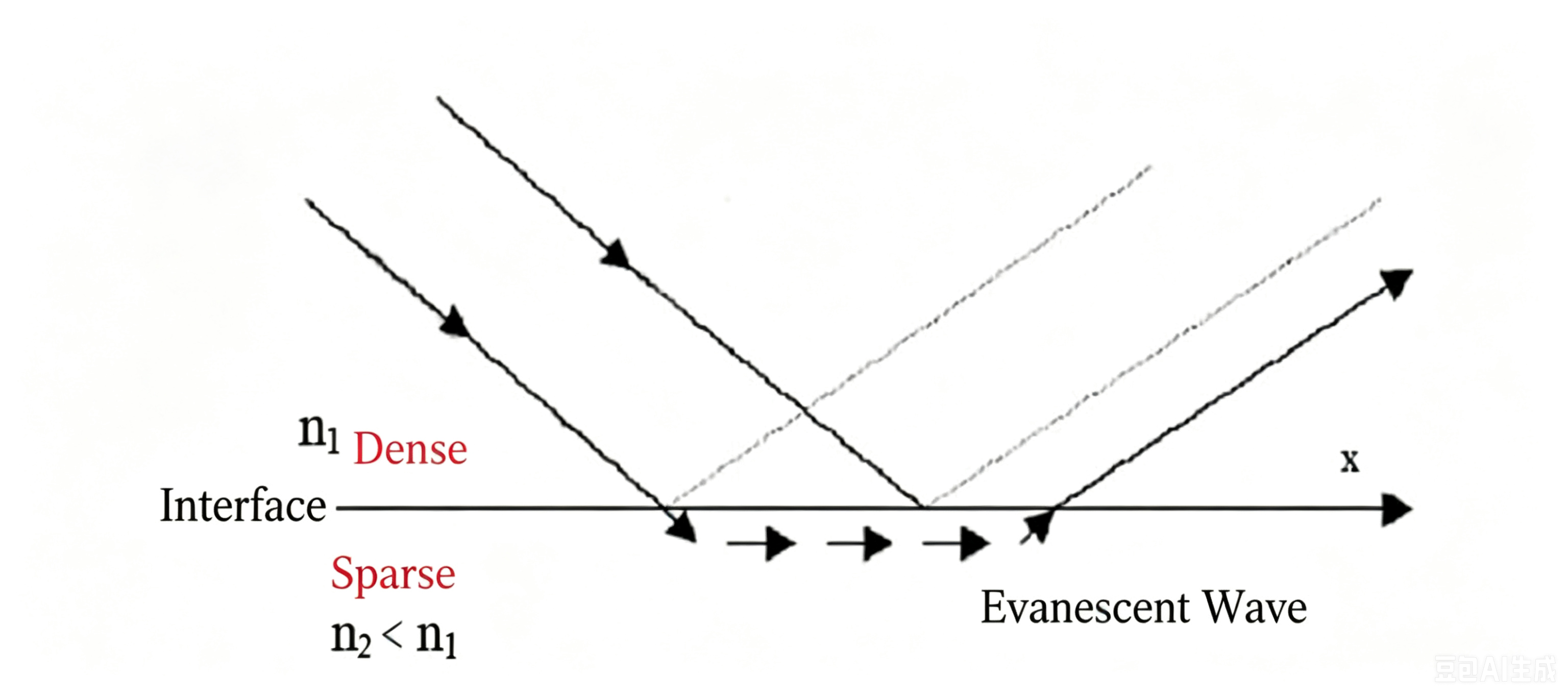
Now, let’s examine the detection principle of SPR:
When P-polarized light (electromagnetic waves) emitted from a light source strikes a prism at a specific angle, both reflection and refraction occur at the interface between the prism and the metal. If the incident angle exceeds the critical angle, total internal reflection (TIR) takes place. Under TIR conditions, the electric field does not immediately vanish at the prism-metal interface. Instead, it generates an evanescent wave that penetrates the metal with an exponentially decaying amplitude.Simultaneously, this evanescent wave excites surface plasmon waves (SPWs)—collective oscillations of free electrons in the metal. When the surface plasmon wave and the evanescent wave resonate, the intensity of the reflected light drops sharply because energy is transferred from photons to the surface plasmons. Most of the incident light’s energy is absorbed by the SPWs, causing a dramatic reduction in reflected light energy.For a fixed incident wavelength, the reflected light intensity is a function of the incident angle. The angle at which the reflected intensity reaches its minimum is called the resonance angle.Key sensitivity of SPR: The resonance is highly sensitive to changes in the refractive index of the medium attached to the metal film’s surface. Any alteration in the surface’s properties (e.g., molecular binding or adsorption) shifts the resonance angle. Thus, the SPR spectrum (resonance angle shift vs. time) directly reflects dynamic interactions at the metal-film interface.
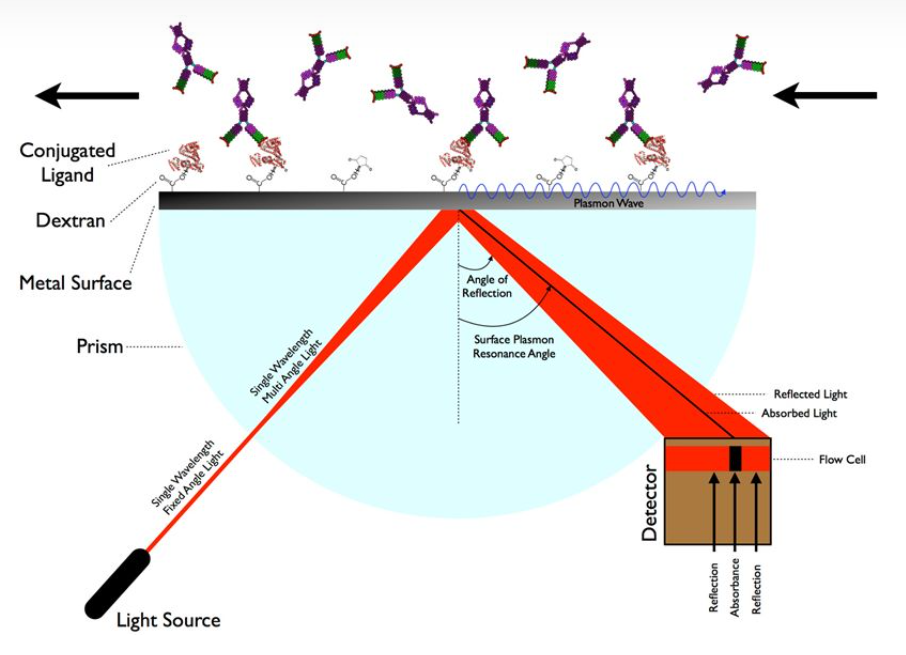
The above diagram illustrates the working principle of the SPR chip. Here, the SPR chip refers to a metal surface coated with dextran, where the amino terminus of the ligand protein can bind to the dextran, thereby immobilizing it onto the metal surface. A monochromatic laser beam emitted from the light source below enters the prism, resulting in multi-angle light incidence on the metal surface. Almost all incident light is reflected, with one exception: when the incident angle reaches a specific value, the photon energy is absorbed by the metal and converted into surface plasmon waves. At this angle, no light is reflected, and only a very weak signal is detected by the sensor. This angle is called the resonance angle. Since plasmon waves propagate along the metal surface, any interaction between the ligand protein immobilized on the metal surface and other substances will cause a shift in the resonance angle.
Currently, SPR technology is primarily applied in the following fields:
I. Drug and Biologics Development
1. Targeted drug screening
2. Lead compound optimization
3. Antibody screening and optimization
4. Drug activity determination and mechanism analysis
II. Life Sciences and Medical Research
1. Functional proteomics
2. Structural proteomics
3. Basic medical research in oncology, immunology, and pathogenic microbiology
III. Other Application Fields
1. Quality control of biologics
2. Food safety assessment
Reference source:https://zhuanlan.zhihu.com/p/423875089
https://www.zhihu.com/search?type=content&q=spr%E4%BA%B2%E5%92%8C%E5%8A%9B%E6%B5%8B%E5%AE%9A
- SPR Surface Plasmon Resonance
- SPR affinity determination
- Affinity detection

- Protein Platform
- Protein Expression Services
- Protein Modification & Detection Services
- Protein Interaction Services
- Protein Purification Service
- Antibody Discovery Platform
- VHH Antibody Platform
- Phage Display Platform
- Antibody Humanization Platform
- Single B Cell Screening Platform
- Antibody Expression & Validation Platform
- Peptide Library Platform
- Custom Antibody Platform
- Innovative Drug Discovery Platform
- Product Center
- Proteins
- Antibodies
- Raw Materials Reagents
- Small Molecule Reagents
- Peptide Products
- Nanoparticle Products
- Contact Us
- Phone:400-621-6806
- Mobile:13110936064(WeC
- E-mail:[email protected]
- Address:Room 108, Building 10, No. 6 Hechang Road, Wuqing Development Zone, Tianjin City
-

WeChat
-

Service Account
-
 400-621-6806
 -
 3599163699
 -
 Monday to Friday 9:00-18:00
 -

-
 0
0
-
