Home
>>
Technical Platform
>>
Detection Platform
>>
SPR Affinity Measurement Service
Download Center
Quick Inquiry & Consultation
SPR Affinity Measurement Service

Surface Plasmon Resonance (SPR) is an optical, label-free measurement technology that enables real-time monitoring of interactions between two or more molecules by tracking signal changes on a sensor chip, with the SPR signal presented via changes in refractive index. SPR affinity measurement is characterized by its high throughput, flexibility, and sensitivity, making it suitable for early-stage drug development and preclinical drug screening.

KMD Bioscience has established a comprehensive Biacore Platform based on SPR technology to provide rapid and efficient SPR Measurement Services tailored to customer needs. Our completed projects cover a variety of affinity measurements, including protein–protein, protein–peptide, protein–small molecule, and antigen–antibody interactions. Leveraging extensive expertise in biomolecular interaction research, our scientists delivers accurate and reliable measurement services to support scientific research.
Surface Plasmon Resonance (SPR)

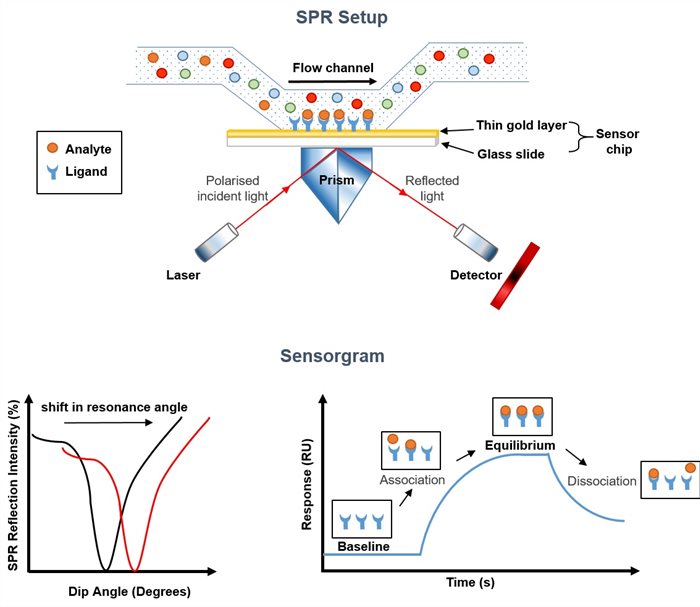
SPR is an optical phenomenon occurring naturally when light undergoes total internal reflection at the interface between a prism and a metal film, generating an evanescent wave that penetrates into the rarer medium. If the medium (commonly a noble metal) supports a plasmon wave, resonance may occur between the two wave modes under energy conservation conditions. SPR technology applies this classical optical phenomenon to develop a biosensing approach for analyzing biomolecular interactions. By observing the interactions between ligands and analytes immobilized on a biosensor chip, changes in the resonance angle (SPR angle) of polarized light at the critical angle between two media of differing refractive indices can be monitored. Resonance leads to significant attenuation of reflected light, and at a specific incidence angle, complete disappearance of reflected light can be observed. Dynamic monitoring of SPR angle changes during a biological reaction yields specific signals reflecting molecular binding and interactions.

表面离子共振法原理图-卡梅德科技.jpg

Schematic diagram of Surface Plasmon Resonance (SPR) principle

Advantages of SPR Technology

Compared with conventional affinity measurement methods, SPR offers the following advantages:

1. No purification or labeling is required for any molecules during measurement.

2. Real-time monitoring of the dynamic reaction process.

3. Rapid acquisition of results, ensuring high work efficiency.

4. Higher sensitivity in measuring low-affinity antibodies.

Detection type

We can provide SPR measurements for various sample types, including but not limited to small molecules, proteins, nucleic acids, lipids, bacteria, viruses, and whole cells. Multiple types of biomolecular information can be provided, including binding specificity, concentration analysis, kinetics and affinity analysis, as well as thermodynamic data.

SPR affinity measurement is also applicable to qualitative studies for confirming interaction specificity. It can monitor many sequential binding events, as each individual event results in a mass increase on the sensor chip surface, and all stages of the binding process are monitored. Examples include epitope mapping, antibody isotyping, and immunogenicity measurement.

Most chemical and spectroscopic methods for quantifying proteins (1) measure total protein content and (2) cannot distinguish between active and inactive molecules, nor can they be applied directly to unpurified samples. Since SPR is a non-invasive method (no light penetration through the sample), it can measure small amounts of analyte molecules from complex matrices, such as food, serum or plasma, and cell extracts. Both direct and indirect (inhibition or competition) methods are feasible for concentration measurement. SPR biosensors are particularly suitable for measuring kinetic association and dissociation rate constants through real-time monitoring of binding interactions.

SPR传感器表面吸附牛血清蛋白-卡梅德科技.png

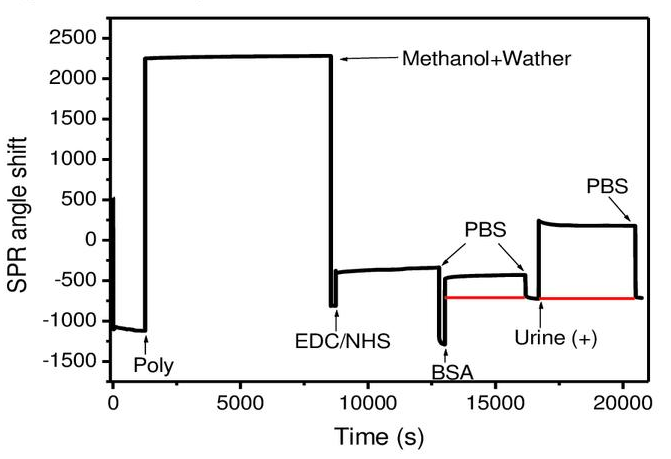
Figure 2 SPR sensor surface adsorption of bovine serum protein

Characteristics of SPR Affinity Measurement

-- Stable performance. In specific application scenarios, such as when proteins are particularly valuable, affinity data obtained are generally high.

-- For many small molecules, stringent buffer conditions are required, and sensor chips are relatively expensive.

Sample requirements

Customer-provided Samples

Requirements

Customers may provide antibodies, proteins, peptides, or small-molecule compounds

* Buffer: PBS, HEPPS, etc., free of organic reagents; must not contain Tris or other reagents with amino groups; avoid glycerol, imidazole, trehalose, EDTA, DTT or other salts as much as possible.

* Protein: >200 μg with tags; >200 μg without tags; concentration >0.5 mg/ml; purity >90%; avoid particulate matter or flocculent precipitates.

* Antibody: >100 μg; concentration >0.1 mg/ml; purity >90%; avoid particulate matter or flocculent precipitates.

* Polypeptide: >200 μg with biotin label; >2 mg without biotin label; concentration >0.1 mg/ml; purity >90%; avoid particulate matter or flocculent precipitates.

* Small-molecule compounds: 1 mg; concentration >1 mg/ml; purity >90%; dissolve in 100% DMSO or water.

Service advantages

-- Professional technical team with extensive experience.

-- High measurement efficiency, label-free and real-time monitoring.

-- Advanced instrumentation.

-- Broad application range: suitable for protein, nucleic acid, polypeptides, and nanomaterial interaction analysis.

-- One-stop service: providing integrated solutions from affinity measurement to molecular interaction studies.

Login

Don’t have an account?Sign Up Now

Register

Already have an account?Log In Now