Mouse CD226 Protein, His Tag
-
Product Number
KMP2322
-
Alias
白细胞分化抗原, CD226 antigen, CD226
-
Specifications
- 50ug
- 100ug
- 200ug
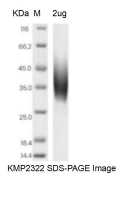
KMP2322
白细胞分化抗原, CD226 antigen, CD226
| Alias | 白细胞分化抗原, CD226 antigen, CD226 |
| Catalog Number | KMP2322 |
| Product Description | The Mouse CD226 Protein(KMP2322) is produced in HEK293 Cells and the target gene encoding Glu19-Pro254 is expressed with a 6His tag at the C-terminus. |
| Molecular Name | CD226 |
| Species | Mouse |
| Host | HEK293 Cells |
| Size | 50ug, 100ug, 200ug |
| Purity | >95% as determined by SDS-PAGE |
| Purification | Affinity purification |
| Endotoxin | <1.0 EU/ug determined by the LAL method |
| Formulation | PBS, pH7.4 |
| Background | Mouse DNAX accessory molecule-1(DNAM-1) is a type I transmembrane glycoprotein that belongs to the immunoglobulin superfamily. As an activating receptor, it interacts with the ligands CD155 and CD112, and activates natural killer(NK) cells via its immu-noreceptor tyrosine-based activatory motif(ITAM). Mature mouse DNAM-1 has extracellular domain(ECD) that contains two Ig-like C2-set domains, and possesses a cytoplasmic region that contains motifs for binding PDZ domains. DNAM-1 is expressed on several lymphoid and myeloid cell types and interacts with CD155/PVR and Nectin-2/CD112. Ligation of DNAM-1 promotes the activation of NK cells, CD8+ T cells, and mast cells, induces dendritic cell maturation, initiates megakaryocyte and activated platelet adhesion to vascular endothelial cells, and stimulates monocyte extravasation- Conversely, it inhibits the formation of osteoclasts. Platelet-endothelium interactions that are mediated by DNAM-1 enable the metastasis of tumor cells to the lung. |
| SDS-PAGE | |
| Predicted Molecular Weight | 27.61 kDa |
| Storage Condition | Aliquot and store at -20℃ to -80℃. Avoid repeated freezing and thawing cycles. |
| Shipping Condition | In general, the proteins are provided as lyophilized powder which are shipped at ambient temperature. They are shipped out in dry ice if supplied in liquid form. |
| Uniprot ID | Q8K4F0 |
| Function | Involved in intercellular adhesion, lymphocyte signaling, cytotoxicity and lymphokine secretion mediated by cytotoxic T-lymphocyte (CTL) and NK cell. Cell surface receptor for NECTIN2. Upon ligand binding, stimulates T-cell proliferation and cytokine production, including that of IL2, IL5, IL10, IL13, and IFNG. Competes with PVRIG for NECTIN2-binding. |



Service Account


 0
0