


Introduction to N-Terminal Sequencing of Proteins
- 2026-07-09
- 417
When analyzing expressed and purified protein products—particularly during the analysis of protein samples—it is necessary to verify the protein’s terminal sequences to ensure the accuracy of the N- and C-terminal sequences of the expressed and purified products. The Edman degradation method is one of the most well-established techniques for analyzing protein N-terminal sequences and is widely used. KMD Bioscience utilizes Shimadzu’s Edman sequencing system (PPSQ-31A) to provide N-terminal sequencing services for purified protein products, antibodies, and protein vaccines to researchers and scientific clients. Our sequencing system can determine the sequence of the first 30 amino acids at the N-terminus. Using a specialized protein loading system, the Edman degradation method can accurately determine the sequence of up to 67 amino acids at the N-terminus of a protein.
Protein N-Terminal Sequencing Technology
I. Principles of Edman Degradation
The PTH method, which uses phenyl isothiocyanate to determine the N-terminal amino acids of a peptide chain, is also known as the Edman degradation method (phenyl isothiocyanate method). The basic principle of the Edman degradation method is that phenyl isothiocyanate (PITC) can undergo a coupling reaction with peptides or proteins containing free amino groups under mild conditions. The resulting phenyl-thioformyl derivative undergoes cyclization, cleaves off from the peptide chain, and is then converted into PTH-amino acid. Because PTH-amino acids exhibit strong absorption under ultraviolet light, they can be identified by chromatography.
Edman degradation sequencing primarily identifies amino acid types one by one from the N-terminus of a protein through cyclic reactions, thereby determining the N-terminal sequence of the protein. Generally, in each sequencing cycle, the PTH-amino acids are first separated by an Edman sequencer, followed by HPLC analysis to determine the PTH-amino acid profile, which is then compared with the standard HPLC profiles of the 20 amino acids to obtain the corresponding amino acid information.
II. Edman Degradation Sequencing Procedure:
① Coupling Reaction: Under alkaline conditions and in a nitrogen atmosphere, phenyl isothiocyanate reacts with the N-terminal amino group to form a derivative of the phenylthioacetyl peptide (PTC-peptide).
② Washing: After removing excess PITC and buffer, the sample is thoroughly dried.
③ Cleavage reaction: Under the action of anhydrous acid, the PTC-peptide undergoes specific cleavage, producing free thiazolidinone of the initial N-terminal amino acid and a truncated peptide that has lost its original N-terminal residue.
④ Extraction: The thiazolidinone is extracted into a hydrophobic organic solvent and separated from the truncated peptide.
⑤ Conversion reaction: Under the action of dilute acid, the unstable thiazolidinone is converted into the stable phenylthiohydrazine amino acid (PTH-amino acid).
⑥ Identification: Identify the PTH-amino acid by analyzing it via TLC or HPLC and comparing the results with standard spectra.
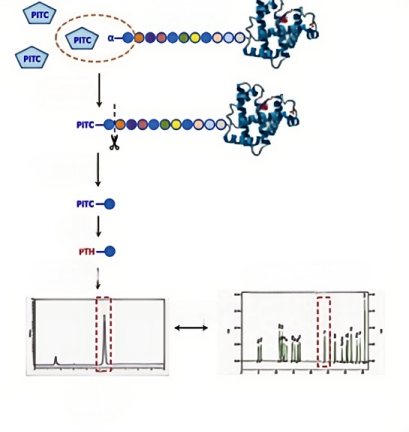
Figure 1: The Edman sequencing process for proteins
Limitations of N-Terminal Sequencing of Proteins
The Edman degradation method, as the gold standard for determining the N-terminal sequence of protein samples, has been widely adopted. However, in practical applications, this method also has certain limitations. For example, when sequencing the N-terminus of a protein, no signal is detected during the sequencing process after the sample is transferred to a PVDF membrane, and this result is consistent across repeated experiments, suggesting that the protein’s N-terminus may have been blocked.
When the N-terminus of a protein is unblocked, it possesses a free α-amino group; the reaction of PITC with this α-amino group is the first step in the Edman degradation sequencing reaction. When the N-terminus of a protein is blocked, the α-amino group at the N-terminus is modified, resulting in the absence of a free α-amino group. This prevents PITC from binding to the protein, thereby halting the Edman degradation reaction. In fact, in nature, 50% of native proteins have modified N-termini; common modifications include acetylation, methylation, and pyroglutamylation. Additionally, N-terminal blocking modifications can sometimes occur during the separation and purification of protein samples. This is primarily caused by detergents or chemicals in the solution reacting with the functional groups at the N-terminus of the protein sample, or by the pH of the solvents used for separation and purification being too high.
Currently, the Edman degradation method cannot be used for sequencing when the N-terminus of a protein is blocked. In such cases, the protein can be cleaved into peptide fragments using proteases, and the sequence can then be determined via liquid chromatography-mass spectrometry (LC-MS). If the modification causing the N-terminal blockage is known, a corresponding protease can be used to remove the N-terminal modification, after which the Edman degradation reaction can be performed for sequencing. For example, many antibody-based therapeutics have a pyroglutamic acid cyclization block at the N-terminus; after digestion with pyroglutaminase, the antibody can be sequenced directly using the Edman degradation method.
Biological Functions of N-Terminal Sequencing
Protein synthesis begins at the N-terminus, and the sequence composition of the N-terminus influences the protein’s overall biological function. By revealing the initiation site of the protein polypeptide chain, investigating protein modifications and functional domains, studying protein isoforms and variants, and supporting applications in drug discovery and biopharmaceutical development, N-terminal sequencing provides a key tool for unraveling the mysteries of proteins. In the future, with continuous technological advancements, N-terminal sequencing will continue to make significant contributions to the development of protein research and the biopharmaceutical field.
KMD Bioscience specializes in the characterization of biopharmaceuticals using bio-mass spectrometry, mass spectrometric analysis of macromolecules (including proteins, peptides, and metabolites), and small-molecule detection services. The company operates independent laboratories dedicated to proteomics, interactomics, and molecular and cellular biology. The laboratories are equipped with large-scale precision instruments such as liquid chromatography–mass spectrometry (LC-MS) systems, gas chromatography–mass spectrometry (GC-MS) systems, and isoelectric focusing systems, as well as various specialized analytical and testing devices. This ensures the traceability of data and the accuracy of experimental results.
This article is intended as a reference for science enthusiasts. It is not a substitute for professional expertise or practical experimental procedures that require more detailed and specialized information. If any content infringes on copyright, please contact the author to have the disputed material removed immediately.
- Protein N-Terminal Sequencing Service: Edman Degradation Method

- Protein Platform
- Protein Expression Services
- Protein Modification & Detection Services
- Protein Interaction Services
- Protein Purification Service
- Antibody Discovery Platform
- VHH Antibody Platform
- Phage Display Platform
- Antibody Humanization Platform
- Single B Cell Screening Platform
- Antibody Expression & Validation Platform
- Peptide Library Platform
- Custom Antibody Platform
- Innovative Drug Discovery Platform
- Product Center
- Proteins
- Antibodies
- Raw Materials Reagents
- Small Molecule Reagents
- Peptide Products
- Nanoparticle Products
- Contact Us
- Phone:400-621-6806
- Mobile:13110936064(WeC
- E-mail:[email protected]
- Address:Room 108, Building 10, No. 6 Hechang Road, Wuqing Development Zone, Tianjin City
-

WeChat
-

Service Account
-
 400-621-6806
 -
 3599163699
 -
 Monday to Friday 9:00-18:00
 -

-
 0
0
-
