


Common Issues in qPCR Experiments
- 2026-07-10
- 440
1、Question: How to improve poor experimental repeatability?
Answer:
(1) Possible Cause: Inaccurate pipetting during sample loading.
Suggestion: Try using a different pipette for the experiment, or consider scaling up the amplification reaction volume.
(2) Possible Cause: The qPCR instrument has not been calibrated regularly, leading to temperature variations across different wells/blocks.
Suggestion: Ensure the instrument undergoes routine calibration and performance verification.
(3) Possible Cause: The qPCR reaction mix was not thoroughly mixed prior to the experiment.
Suggestion: Mix the reaction solution thoroughly and gently by vortexing followed by brief centrifugation before aliquoting into the reaction plates/tubes.
2、Question: What are the causes of unusually high (late) Ct values in qPCR?
Answer:
(1) Template Issues:
Cause: The template DNA/cDNA may be degraded or of low quality.
Solution: Re-prepare the template nucleic acid using a validated protocol.
(2) Suboptimal Reaction Conditions or Poor Primer Design:
Cause: Inefficient amplification due to unoptimized reaction components (e.g., Mg²⁺ concentration) or poorly designed primers (e.g., low specificity, secondary structure).
Solution: Perform a standard curve analysis to check the amplification efficiency. Redesign primers if efficiency is outside the 90-110% range.
(3) Technical Errors During Setup:
Cause: Insufficient template added, degradation of critical reaction components (e.g., enzymes, nucleotides), or evaporation due to improper plate sealing.
Solution: Carefully check pipetting accuracy, use fresh aliquots of reagents, and ensure reaction plates/tubes are properly sealed.
(4) Excessive Amplicon Length:
Cause: The target amplicon may be too long (>300 bp for some assays) for optimal efficiency under standard two-step cycling conditions.
Solution: Switch to a three-step cycling protocol or redesign primers to generate a shorter amplicon (ideally 80-200 bp).
(5) Presence of PCR Inhibitors:
Cause: Carryover of inhibitors from the sample (e.g., heparin, hemoglobin, salts, phenol) during template preparation.
Solution: Increase the dilution factor of the template to reduce inhibitor concentration, or re-purify the template using a method effective for inhibitor removal.
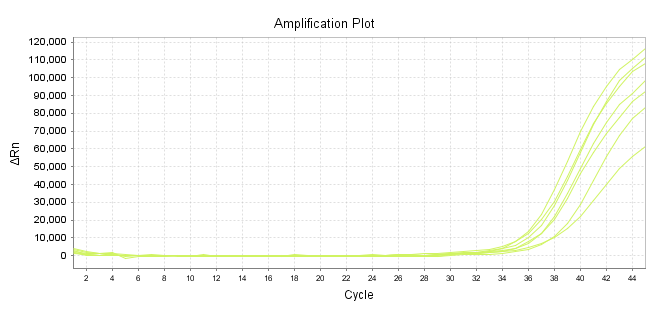
3. Question: The melting curve does not show a single peak.
Answer:
(1) Non-specific amplification:
Causes: This can occur due to suboptimal amplification conditions or issues with primer design. Excessively high primer concentration can also contribute.
Solutions:
Optimize the amplification conditions (e.g., annealing temperature, Mg²⁺ concentration).
Review and potentially redesign the primers for better specificity.
If primer concentration is suspected to be too high, dilute the primers appropriately and repeat the experiment.
(2) Contaminated template DNA:
Cause: The template DNA may be contaminated with other nucleic acids or primers.
Solution: Use a freshly prepared, high-quality cDNA/DNA template for the reaction.
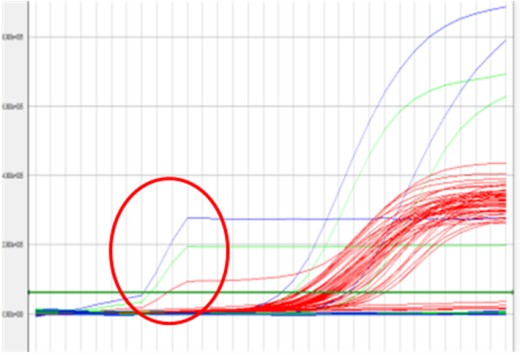
4. Question: While the amplification curves from most wells appear normal, a few wells show irregular curves (as shown in the figure). What could be the cause?
Answer:
Bubbles on the solution surface in the well may be the cause. Bubbles can refract fluorescence, and when they burst, they cause sudden changes in the fluorescent signal, interfering with its accurate detection. During the experiment, care should be taken to minimize bubble formation.
5. Question: Why does the plateau phase of the PCR amplification curve appear jagged or uneven?
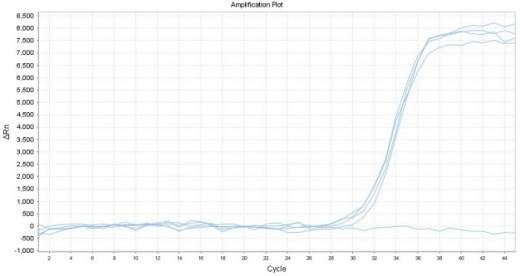
Answer: This may be caused by low RNA purity. You can perform a gradient dilution of the template to observe the optimization effect, or prepare a new batch of high-purity RNA for the experiment.
6. Question: Why are the peaks in the melting curve messy or irregular?
Answer:
(1) Contamination in the reaction system:
Investigate the cause by testing blank controls containing individual components, such as water, enzyme, and primers, to identify and eliminate the source of contamination.
(2) Degradation of reagents due to repeated freeze-thaw cycles or improper storage:
Perform a comparative experiment using fresh, newly prepared reagents to rule out reagent-related issues.
(3) Instrument malfunction or misalignment:
If the instrument has been idle for an extended period, consider performing instrument calibration and maintenance to ensure optimal performance.
- qPCR
- qPCR experiments

- Protein Platform
- Protein Expression Services
- Protein Modification & Detection Services
- Protein Interaction Services
- Protein Purification Service
- Antibody Discovery Platform
- VHH Antibody Platform
- Phage Display Platform
- Antibody Humanization Platform
- Single B Cell Screening Platform
- Antibody Expression & Validation Platform
- Peptide Library Platform
- Custom Antibody Platform
- Innovative Drug Discovery Platform
- Product Center
- Proteins
- Antibodies
- Raw Materials Reagents
- Small Molecule Reagents
- Peptide Products
- Nanoparticle Products
- Contact Us
- Phone:400-621-6806
- Mobile:13110936064(WeC
- E-mail:[email protected]
- Address:Room 108, Building 10, No. 6 Hechang Road, Wuqing Development Zone, Tianjin City
-

WeChat
-

Service Account
-
 400-621-6806
 -
 3599163699
 -
 Monday to Friday 9:00-18:00
 -

-
 0
0
-
