Home
>>
Antibody Platform
>>
Custom Antibody Platform
>>
Bovine pAb Production Services
Download Center
Quick Inquiry & Consultation
Bovine pAb Production Services

KMD Bioscience has dedicated years to antibody preparation research. Our company possesses professional technicians with extensive experience in antibody preparation, enabling us to offer custom services including polyclonal and monoclonal antibodies. Polyclonal antibodies (pAbs) are a collection of immunoglobulins produced by multiple B lymphocytes, found in the serum of immunized animals and obtained by immunizing a host with an antigen. Compared to monoclonal antibodies (mAbs), pAbs recognize multiple epitopes on the same antigen, offering superior affinity and faster binding kinetics. Their advantages, such as the ability to cause agglutination and precipitation reactions, make them widely applicable in immunological diagnostics. KMD Bioscience is committed to providing high-quality Antibody Production Services. We have established a mature and comprehensive Antibody Preparation Platform, offering pAb services for diverse species including bovine, murine, ovine, and rabbit.

Bovine antibodies possess unique characteristics. Approximately 10% of bovine pAbs feature an exceptionally long "loop" within the CDR3 domain. This loop forms a knob-shaped structure primarily mediating the antibody's affinity for the antigen, conferring higher antigen-binding capability. We are dedicated to providing clients with high-immunoreactivity bovine pAbs and related testing services. Validation using various techniques like ELISA, Western Blot, and IHC is available, ensuring the preparation of highly sensitive antibodies, guaranteed delivery quantities, and fulfillment of experimental needs. Within our completed pAb projects, we have successfully generated bovine pAbs exhibiting neutralizing titers exceeding 1:800,000,000.
Characteristics of Bovine Polyclonal Antibodies

The high binding capability of bovine antibodies to their target antigens stems primarily from their ultra-long CDR3 structure (knob structure), which differs significantly from conventional IgG. This knob domain region contains 4 to 12 cysteine residues, crucial for the stability of bovine antibodies. The naturally occurring differences in the complementary structural regions of these antibodies hold high value compared to conventional antibodies. For instance, they excel at discriminating between antigens with subtle differences during vaccine development. This is particularly advantageous in viral vaccine R&D, where distinguishing between different subtypes of the same viral antigen is critical. Furthermore, through our independently designed experimental protocols, we can amplify the advantages of bovine pAbs, such as achieving over a 1,000-fold greater recognition capability for the target antigen compared to similar antigens.

KMD Bioscience offers both Bovine Monoclonal Antibody Preparation Services based on phage display technology and conventional Bovine Polyclonal Antibody Preparation. Concurrently, we provide Customized Antibody Services. Through consultation with our technical team, we can develop personalized experimental plans tailored to your specific requirements, addressing aspects like peptide antigen design and protein antigen preparation specifications.

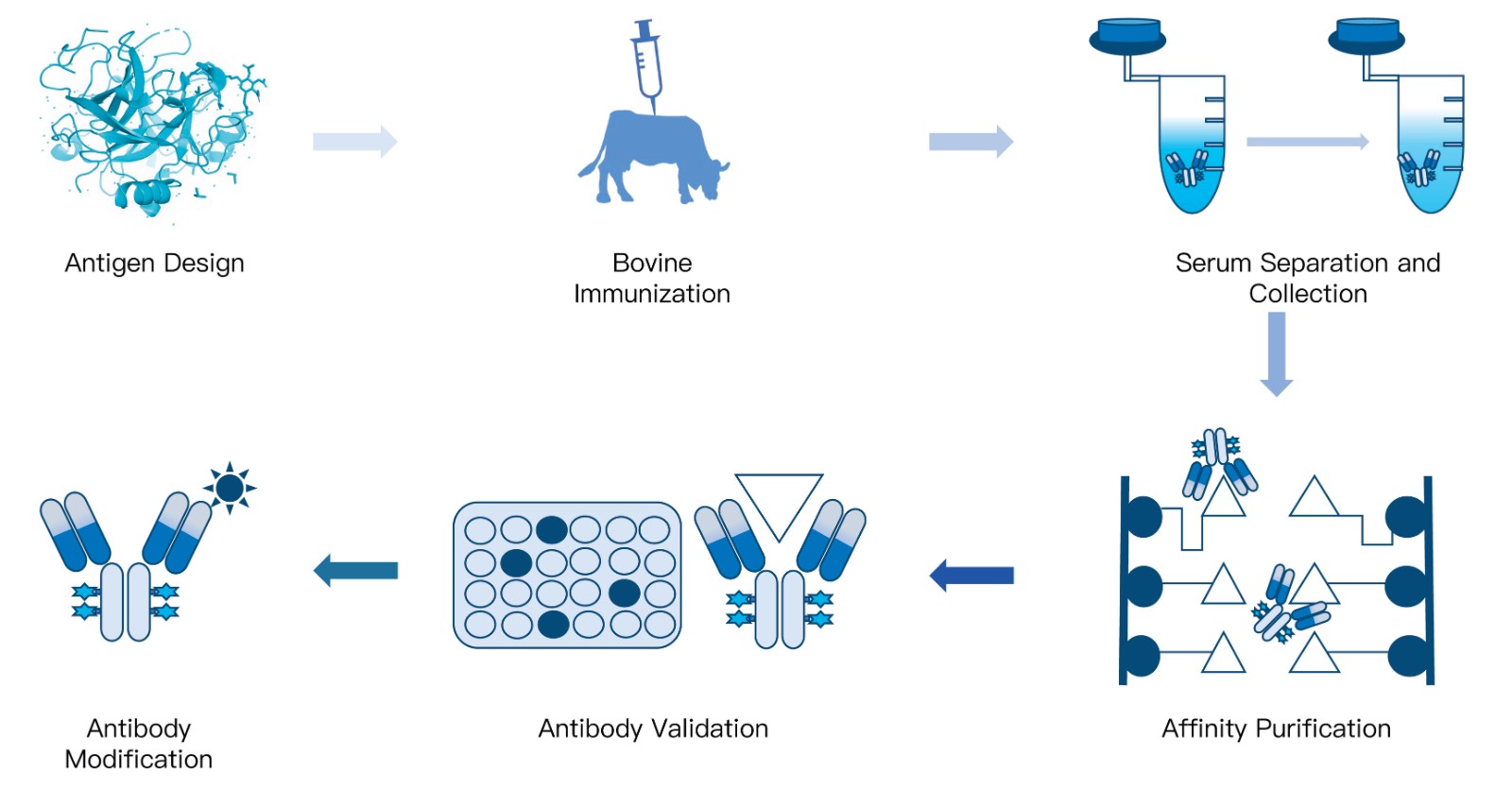
Bovine Polyclonal Antibody Production Process

46-KMDBioscience-polyclonal-antibody-development-service-bovine.jpg

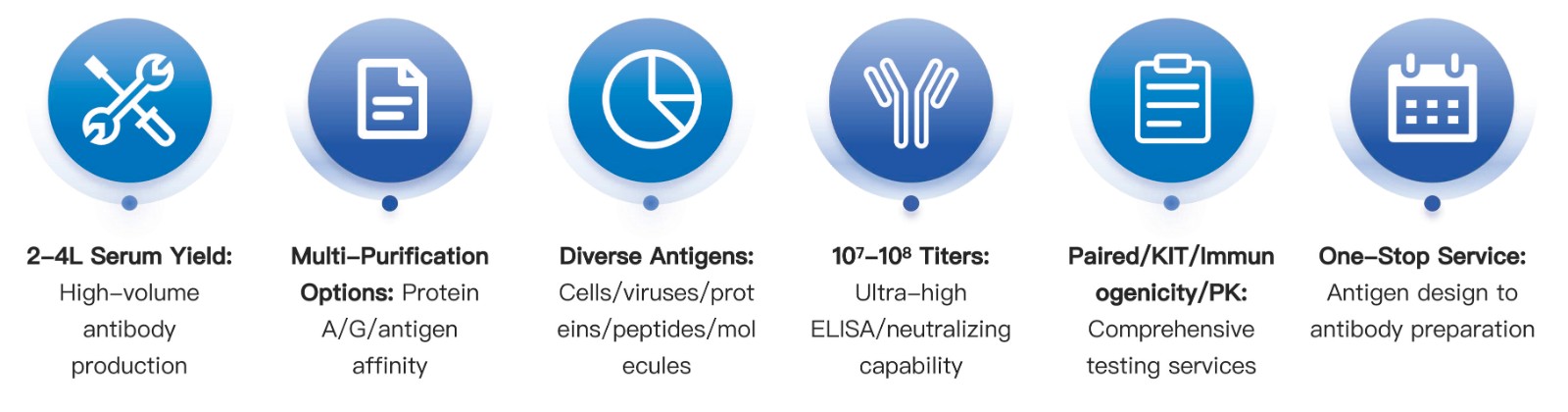
Advantages of Bovine Polyclonal Antibody Production Services

47-KMDBioscience-polyclonal-antibody-development-service-bovine.jpg

Comparative Analysis of Polyclonal Antibodies Across Different Species

Type

Characteristics

Murine pAb

* Utilizes well-established techniques and is a commonly used species.
* Requires less antigen, resulting in lower costs.
* Shorter immunization cycle, suitable for small-scale pAb production.

Rabbit pAb

* Employs a mature preparation system with relatively low cost.
* Abundant commercial availability of anti-rabbit secondary antibodies, ideal for detection.
* Exhibits higher affinity than murine pAbs and recognizes a broader range of epitopes.

Alpaca pAb

* Single-domain antibodies are smaller and more flexible, enabling recognition of epitopes inaccessible to traditional antibodies.
* Easier to humanize.
* Better tolerance to a wide range of temperatures or pH conditions.

Chicken pAb

* Requires small antigen amounts with high unit yield.
* High specificity and stable properties.
* Reacts well with highly conserved mammalian antigens.

Login

Don’t have an account?Sign Up Now

Register

Already have an account?Log In Now